Book
Read This If You're Scaling
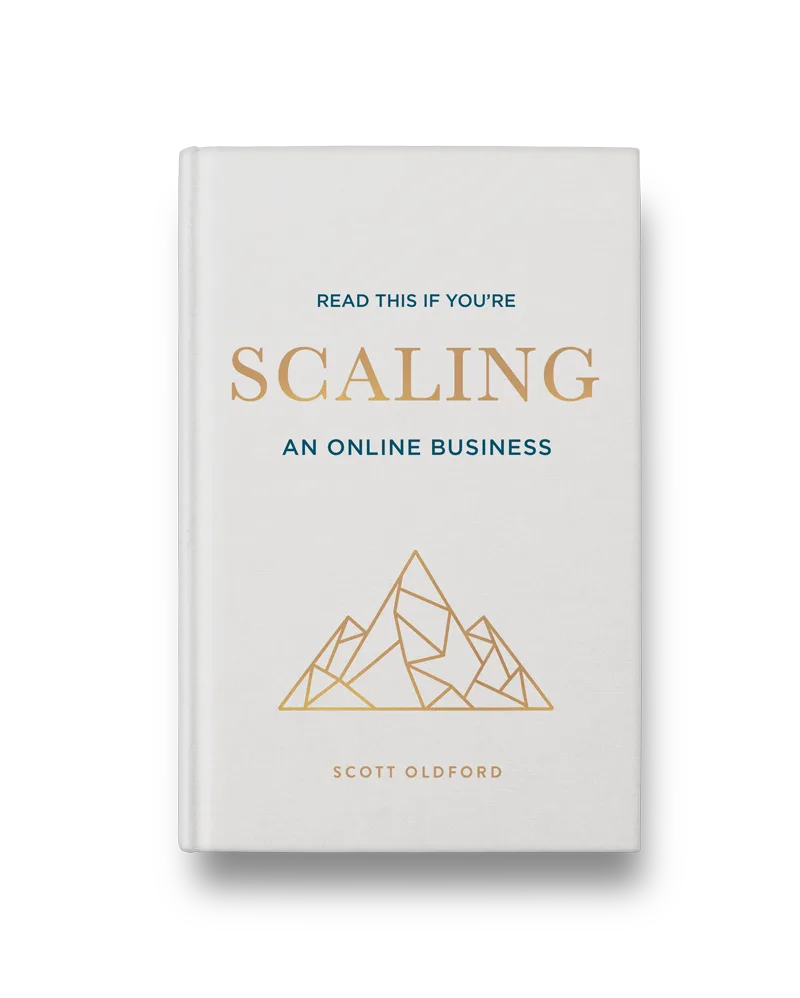
Read This If You're Scaling is the framework-guide version of my scaling material, written for the Entrepreneur who has already crossed roughly $25,000 a month and is stuck in the specific gap between building a business and scaling one. It is the living update to the 6 Pillars from The Nuclear Effect, taught with almost no narrative padding: nine named frameworks, chapter-ending worksheets, and a diagnostic structure instead of a story arc. It changed how I taught scaling by separating "why is this breaking" from "what should I do about it," and giving each its own tool.
This page teaches the book's core arguments, gives you one full excerpt from inside it, and tells you straight who should buy it and who should read something else first. If you want the direct playbook version, this is that book. If you want the narrative version of the same material, look elsewhere in the nine.
What the Book Argues
The thesis sits in two lines from the intro: "Scaling without alignment is just another word for slow collapse," and "there's a stage between building and scaling, and if you skip it, scaling will break everything you've built." Most scaling advice assumes you already know what's broken and just need tactics. This book assumes the opposite. It assumes you don't know which pillar is failing, and it spends its length building the diagnostic tools to find out before it hands you a single tactic.
The book opens with a compressed cold-open: I scaled my first 7-figure business at 16, and it wasn't strategic or sustainable, it just happened, right place, right time, wrong nervous system. That line sets up the whole book's argument. Scaling that happens to you instead of through you eventually collapses, and the frameworks that follow exist to put you back in the driver's seat.
### The Harmony Triangle and the order of operations
The first framework is the Harmony Triangle: You, the energy and nervous system and health and fulfillment side, the Business, meaning systems, team, profitability, structure, and the Customer, meaning delivery, transformation, experience. Most Entrepreneurs pour energy into these three unevenly. Some neglect themselves in service of the customer. Some over-serve the business and wonder why they're exhausted. Some obsess over customer results but forget to build a business that's scalable at all. When one side is out of balance, the whole triangle tilts.
The book states the order of operations directly, and it's the opposite of what most people assume: You, then the Business, then the Customer. Most people put the customer first, the business second, and themselves last, and that's a formula for chronic overgiving and eventual collapse. If you aren't regulated, resourced, and aligned, the business can't function in harmony. If the business isn't structured and supported, it can't deliver the transformation your customer needs. Only when both of those are true does the customer get served the way they're supposed to be, and only then do you get real results, referrals, and momentum.
### The 6 Pillars, taught as a diagnostic
Chapter 2 rebuilds the 6 Pillars from The Nuclear Effect as a diagnostic lens rather than a list. Every challenge in your business maps to one or more of Marketing, Sales, Operations, Delivery, Finance, or Mindset, and most Entrepreneurs plateau not from a lack of ambition but because they don't know which pillar is breaking down underneath the symptom they're seeing. A sales problem is often a delivery issue, or an ops bottleneck, or a mindset glitch wearing sales symptoms, and if you don't know which part of the machine is off, you overwork, overhire, overspend, and underperform despite real momentum. This entry point deserves its own dedicated read if you want the full pillar breakdown: see The 6 Pillars.
### Levels of Consciousness and why funnels mismatch
Chapter 5 maps three operating states onto buyer language: Willful (push, hustle, react), Intellectual (analyze, optimize, understand), and Intuitive (align, trust, flow). "How many spots are left?" is Willful language. "Can you show me the ROI?" is Intellectual. "I trust you" is Intuitive. The book's sharpest tactical point follows directly from this: if your ad is written for Willful and your landing page is written for Intuitive, it will not convert, because you're speaking two different energetic languages to the same buyer, and that mismatch breaks trust faster than bad copy ever could. The fix is matching the register of the whole funnel to the register of the traffic, not writing better copy.
### Money as energy, and the 6 Levels of Motivation
Chapter 6 reframes money as something that moves rather than something that sits. If money doesn't move, it dies. If money doesn't have a direction, it disappears. You don't attract what you want, you attract what you can hold, and people pay you for the energy you save them, give them, or activate in them, not just for the deliverable.
Chapter 7 lays out six levels of entrepreneurial motivation, Safety through Possessions, Goals, Certainty, Ripple, and Legacy, with an explicit rule that you cannot skip levels. You cannot jump to Level 5 or 6 if you're still trying to figure out rent. Trying to be purpose-driven when your nervous system is in survival mode creates shame, not impact. Every level has its own medicine, and the fastest way through a level is to fully inhabit it rather than rush past it.
### Debt, revenue, and the Growth/Profit/Invest split
Two of the book's more contrarian arguments live in the money chapters. First, debt fear is trauma, not strategy. Most Entrepreneurs avoid debt even when the ROI is clear, not because of the math but because of fear of shame, fear of collapse, fear of becoming like their parents. Borrowing $50K at 20% to create $250K in revenue is not a liability. It's an engine, once you understand the mechanics of smart debt. Second, revenue isn't wealth, and running a business forever isn't a wealth strategy. Most Entrepreneurs stay on the earning hamster wheel, make money, spend money, repeat, without ever building the asset side. The book pairs this with Growth Mode, Profit Mode, and Invest Mode as three seasons a business moves through, and argues that one of the biggest planning errors is trying to scale like you're in Growth Mode while your business needs Profit Mode, or trying to preserve cash when the business should be planting for the future.
### Identity, capacity, and the CEO Dashboard
The back half of the book turns from strategy to the founder doing the scaling. At every new level, a version of you has to die: the overworker, the people pleaser, the martyr, the control freak, the prove-yourself hustler. If you're still operating with the mind of your former self, you recreate old patterns with more money and more stress attached. Chapter 24 names the shift directly: operators get pulled into everything, architects build from above. Operators ask what's next. Architects ask what's working, what's not, and what needs to shift. The CEO Dashboard, five components covering business pulse, the 90-day plan, leadership check-in, offer and funnel visibility, and a team/time/energy audit, is the bridge from one identity to the other.
The last framework here is Capacity versus Capability. Capability is "I can do this." Capacity is "I can do this and stay regulated, fulfilled, and sovereign while I do it." You may be capable of the next hire, the next launch, the next yes, but if your nervous system isn't aligned with the decision, it's not expansion, it's energetic debt you'll pay down later.
From the book: "The Real Order of Operations"
From the book
The following is the book's original text, reproduced verbatim including its own punctuation.
Most people put the customer first, the business second, and themselves last.
That's a formula for chronic overgiving and eventual collapse.
Here's the real order of operations for scalable, sustainable growth:
You → The Business → The Customer.
Because…
If you aren't regulated, resourced, and aligned… the business can't function in harmony.
If the business isn't structured and supported… it can't deliver the experience or transformation your customer needs.
And only when the customer is truly supported through a business that flows from your clarity… do you create real results, referrals, and momentum.
It's counterintuitive.
But it's foundational.
Your body keeps score—of everything.
It remembers the 5am alarms. The missed meals. The projects you pushed through when you were fried. It holds your stress, your shame, your urgency.
The body doesn't lie.
You might convince your mind that you're fine. But your body knows if you're in survival mode.
And if your body doesn't feel safe? It will resist growth. It will sabotage momentum. It will burn out under the weight of what your mind is forcing.
Entrepreneurs ignore this one the most.
You want to double your revenue? Double your nervous system's ability to hold pressure, receive, and rest.
But most pour unevenly.
Some neglect themselves in service of the customer. Some over-serve the business and wonder why they're exhausted. Some obsess over customer results but forget to build a business that's scalable.
And when even one side of this triangle is out of balance?
The whole thing tilts.
Who This Book Is For
This book is for the Entrepreneur who is 7-figure-bound and wants the direct playbook version, not the narrative one. If you're past roughly $25K/month, you have systems, an offer, and an audience, and something is still tangled underneath all of it, this is built for exactly that stage. You'll get more out of it if you like worksheets and diagnostic structure more than story, and if you'd rather diagnose the actual broken pillar yourself than get handed a generic tactic.
This book is not for you if you haven't found product-market fit yet. The frameworks assume traction already exists and diagnose why it isn't compounding into scale, rather than how to get traction in the first place. It's also not the right entry point if you want story and personal history first, narrative is present but kept thin on purpose here, most chapters open with one or two lines of personal anchor before moving straight into framework. And if energetic language, nervous system, frequency, capacity, feels like a stretch for you right now, you may get more immediate traction from the purely operational version of this material.
Where It Sits in the Nine
Where to start
Read This If You're Scaling is the practical, worksheet-driven sibling to The Nuclear Effect, which tells the 6 Pillars through story rather than diagnostic. If you want the origin of the 6 Pillars told as a narrative before you get the compressed diagnostic version here, read The Nuclear Effect first. If you're a coach specifically and want the pillar framework applied directly to a coaching business's ceiling, How to Scale a Coaching Business Past 7 Figures walks through the same capacity-first logic in that specific context. This material also traces back to my original 2018 scaling framework, refreshed and expanded as 7 Steps to 7 Figures, if you want to see where the earlier, simpler version of this thinking started. For the full sequencing across all nine books, see /books/reading-order.
Reader Proof
"Went from making 6-figures, stuck on the hamster wheel to 7-figures and loving my business." - Safrina Kadhri, Feng Shui and Prosper
That's the exact plateau this book is built to diagnose, the stall between six and seven figures that usually presents as a marketing or sales problem while the real cause sits in a pillar, an identity, or a capacity issue underneath.
FAQ
What is Read This If You're Scaling about?
It's a framework-guide for Entrepreneurs past roughly $25K/month who are stuck between building and scaling. It rebuilds the 6 Pillars from The Nuclear Effect as a diagnostic, adds frameworks for energetic capacity, identity, and leadership, and closes each chapter with a worksheet instead of a story.
Do I need to read The Nuclear Effect first?
No, but it helps. The Nuclear Effect tells the 6 Pillars as a story. This book gives you the same framework as a direct diagnostic with worksheets. Either order works, they teach the same core model from two different angles.
Is Read This If You're Scaling worth reading if I'm still under $25K/month?
Probably not yet. The book assumes traction already exists and spends its length diagnosing why that traction isn't compounding into scale. Below that stage, the diagnostic tools will describe problems you haven't hit.
Is this a narrative book or a practical one?
Practical. Most chapters open with one or two lines of personal story, then move straight into framework, diagnostic questions, and a worksheet. If you want the narrative version of this same material, The Nuclear Effect is the better starting point.
What frameworks are inside the book?
The Harmony Triangle, the 6 Pillars, the 4 Energetic Intelligences, Levels of Consciousness in Business, the 6 Levels of Motivation, the 4 Mindsets, the 5 Currencies, the 4-Part Business Model, the CEO Dashboard, and the Energetic Calendar, among others. It's dense with named, worksheet-backed frameworks.
How does this relate to 7 Steps to 7 Figures?
7 Steps to 7 Figures is the 2018 ancestor of this material, since refreshed. Read This If You're Scaling is the fuller, current version of that same core thinking, expanded into nine named frameworks with worksheets.
Get the Book
If the gap between building and scaling is where you are right now, get the full book and worksheets at scalingguide.com.
Get the book and worksheets