Book
The Levels of Consciousness for Business
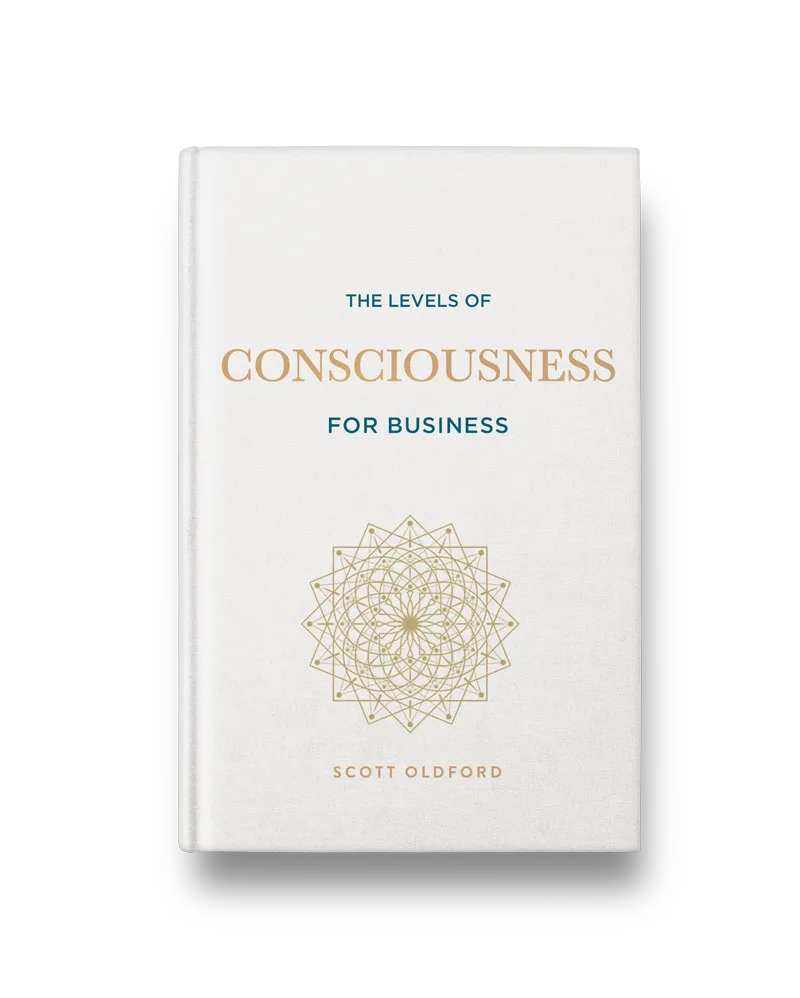
The Levels of Consciousness for Business is Scott Oldford's book on the four levels every business decision runs on: Reactive, Willful, Intellectual, Intuitive. Not three. Four. It is written for Entrepreneurs whose results look fine on paper and don't feel fine to live inside, and it works through twenty real client stories, Scott's own $7-million-year depression, and a diagnostic matrix to show why a strategy that worked at one level fails when borrowed at another.
What the Book Argues
The framework itself is simple enough to state in a sentence: every business decision comes from one of four sources, fear, force, logic, or knowing, and those map to Reactive, Willful, Intellectual, and Intuitive. If you want the framework taught at full depth, the diagnostic, the symptoms, the failure modes, that's the job of the Levels of Consciousness hub. This page is about something the hub can't do for you, which is show you the framework working inside twenty different businesses, in the actual words the book uses, until it stops being an idea and starts being something you recognize in your own last five decisions.
The book opens with the story underneath the theory. Scott generated roughly seven million dollars in a single year while privately falling apart, the year the money finally proved it wasn't going to fix anything. That line is no marketing hook. It's Chapter 1, and it's the reason the rest of the book exists: revenue and consciousness are not the same axis, and a business can be winning by every external measure while the person running it is falling apart with nobody around them noticing.
From there the book moves level by level. Reactive is survival frequency, fear making the call. Willful is the warpath, force and discipline built into an identity that can't rest without guilt. Intellectual is the architect's frequency, systems and logic, with a cost the book names directly as quiet sterility, everything working and nothing feeling alive. Intuitive is the resonance frequency, decisions made from a felt sense of rightness, with its own honest cost, the courage to trust what your metrics can't fully prove. Each level gets its own chapter, its own client stories, and its own pricing and delivery breakdowns, because the book doesn't stop at naming the levels. It shows what an offer, a delivery model, and a team look like at each one.
Two tools do the heavy lifting past the four-level definition. The Consciousness Alignment Matrix scores eleven business dimensions, marketing, offers, team, delivery, and more, against all four levels independently, because most misalignment isn't a founder stuck at one level. It's a founder who's evolved personally while the team is still Reactive and the offer is still speaking to an audience from three years ago. The book is explicit that the goal isn't getting every dimension to Intuitive. The goal is coherence across the layers you have. Alongside it sits the Energetic Reality Ladder, a 1-to-10 embodiment practice adapted from Frederick Dodson's Levels of Energy, which the hub's four-level model doesn't carry at all: you feel into your current level, drop one level lower to understand what staying there costs, then rise two levels to feel what's available to build from. That numeric expansion, four levels stretched into a ten-point felt scale, exists only in the book.
The second half of the book gets granular in a way the hub's overview can't match. There's a full chapter mapping money behavior to five categories of financial memory, Safety, Worthiness, Capacity, Parental Modeling, and Power, with a somatic exercise for repatterning each one. There's a chapter naming pricing as part of frequency architecture, not just a monetization lever, with concrete price ranges built for each level, Reactive offers running around $997 on six-week programs, Intuitive retainers running $30,000 to $60,000 a year, because the book's position is that Intuitive-level work serves a smaller, higher-priced market rather than a bigger one. There's a four-step onboarding ritual, with scripts, for bringing a new hire into alignment with the business rather than just its SOPs. There's an eight-category Team Energetic Alignment Scorecard with real scoring thresholds. None of that is framework-atlas material. It's workbook material, built to be used, not just read.
The book also spends real space on how a level shift happens, because it doesn't happen through gradual effort. Chapter 19 names the mechanism directly: consciousness shifts when an existing identity structure breaks, not when someone decides to try harder at being different. It also names the cost of each individual transition. Moving from Reactive to Willful requires releasing victimhood. Moving from Willful to Intellectual requires releasing an identity built on hustle. Moving from Intellectual to Intuitive requires releasing certainty itself, which is the hardest one for the most competent operators to give up. And the book is careful to say you'll oscillate through all of this, dropping back into an earlier level under pressure, and names that as the model working correctly, not as regression.
The last chapter, "You Are the Field," is where the book gets most personal and most concrete at once, and it's where this page's excerpt comes from.
From the Book: Chapter 20, "You Are the Field"
From the book
Chapter 20 is the book's closing argument, and it's also the most exposed Scott gets in the entire text. He puts his own numbers on the table, the ones that make the paradox undeniable, then walks through what changed in how he ran the business once he stopped optimizing for output and started optimizing for coherence. The excerpt below is verbatim, in the sequence the chapter presents it, including the book's own punctuation and its use of "learnt" and capitalized "Entrepreneur," a documented exception preserved exactly as published.
In 2018 and 2019, I generated over $10 million in 16 months... I had 40 team members. I was on back-to-back sales calls... But it wasn't working for me. Not in the way that matters... Then came 2020. Less revenue than 2018. Less revenue than 2019. And a 79.6% profit margin... That year I added over 100,000 entrepreneurs to my audience. Sold tens of thousands of books. Closed seven figures in revenue through text messages alone.. no pitches, no calls, no performance.
In 2019, I eliminated sales calls... And when I stopped taking them, my conversion rate went up. I want to say that again, plainly. Conversion went up after I removed sales calls.
It turns out forced conversations create forced decisions. Real conversations, when they happen at the right moment, close themselves.
Stillness isn't inaction. It's aligned momentum.
You don't outgrow tactics. You outgrow misalignment.
A misaligned $100K business is uncomfortable. A misaligned $10M business is unbearable.
Higher consciousness does not mean bigger outcomes. It means truer ones.
Being the field means your presence is the infrastructure. Not something you add to the business... My clients aren't buying access to a funnel. They're buying access to me.
The chapter closes the way it opens, with a question instead of a conclusion. Not "how much did it grow." Does it support your health? Strengthen your relationships? Allow breathing room? Feel clean in your body? Four questions, and the book leaves them exactly there, unanswered on the page, because they were never meant to be answered for you.
Who This Book Is For, and Who It Isn't
This book is for the founder whose numbers look fine and whose stomach doesn't. If you've hit a revenue mark that was supposed to fix something internally and it didn't, this is the book that names why, in more depth than a single call or a framework page can carry. It's also for anyone who's copied a strategy, a funnel, a launch sequence, word for word, watched it flop, and assumed they'd done something wrong with the execution. The book's answer is usually that the level match was wrong, not the tactic, and it spends real chapters proving that with client after client.
This book is not for someone who wants a pure tactics manual. If what you need this week is a specific ad script or a subject-line swipe file, the diagnostic and identity work here will feel like a detour. It's also not the right entry point if you haven't yet built anything, the case studies and pricing breakdowns assume you're running a business already, even a small or struggling one, not planning a first one on paper. And if the word "consciousness" makes you reflexively skeptical, the book does address that resistance directly, in the False Ascension chapter, which confronts spiritual language used to dodge a hard conversation, a real deadline, or a real number head on, but it won't convert a determined skeptic in the first fifty pages.
There's also a kind of reader this book stalls out. Someone who wants to be told which level they are, once, as a fixed label, will find the book actively resists that. The Alignment Matrix and the twenty-chapter structure both assume you'll re-run the diagnostic on yourself repeatedly as your business changes underneath you, and a reader looking for a single tidy answer instead of an ongoing practice will find that frustrating rather than clarifying.
Where It Sits in the Nine
Where to start
Read The Pattern either before or alongside this one. The Pattern diagnoses the specific stuck loop underneath a plateau, twelve named patterns like the Overthinking Achiever or the Fear-Driven Grinder, while this book diagnoses the broader operating level those patterns run on top of. Read them together and you get both the zoomed-in mechanism and the zoomed-out frequency. After this book, Resonance goes deeper into the marketing-as-frequency material this book only opens in its Intuitive chapter, and Read This If You're Scaling is the more tactical companion for a founder who's confirmed their level and now needs the operational build-out. See the full sequencing at the reading order guide.
Reader Proof
"Went from making 6-figures, stuck on the hamster wheel to 7-figures and loving my business again." - Safrina Kadhri, Feng Shui and Prosper
That's the identity shift this book is about. Not a bigger number. The difference between running a business and running a nervous system that happens to have a business attached to it. Safrina's result is the exact arc Chapter 20 describes in Scott's own numbers, revenue that didn't need to grow for the business to finally feel like hers again.
FAQ
What is The Levels of Consciousness for Business about?
It's Scott Oldford's book on the four levels, Reactive, Willful, Intellectual, Intuitive, that every business decision comes from. It argues that most strategy failures are level mismatches, not tactical mistakes, and it proves that across twenty client stories plus Scott's own numbers.
Is there a three-level version of this framework?
No, and the book is direct about this being an error when it shows up elsewhere. There are four levels. Reactive is the one most commonly left out, and it's the level where most struggling Entrepreneurs are operating.
Do I need to read the framework hub first?
No. The book is self-contained and teaches the framework from the ground up through story. The hub page is the faster diagnostic route if you want to place yourself on the model today. The book is the deeper route if you want to see the model proven out across twenty different businesses first.
Is this book only for people into "energetics" or spirituality?
No. It has a full chapter, "False Ascension," specifically confronting spiritual language used to avoid hard business decisions, and every level chapter includes pricing breakdowns, financial memory work, and team scorecards that read as operational, not mystical.
How is this different from Scott's other books on similar themes?
The Pattern names the specific stuck loop underneath a plateau. This book names the broader level that loop is running on. Resonance focuses specifically on marketing as frequency. This is the widest-lens book of the three, covering marketing, offers, delivery, operations, team, and finance under one model.
Why did copying someone else's exact strategy not work for me?
Because the strategy was built from a specific level of consciousness, matched to an audience at that same level. The book proves this across multiple client stories, including a section on why a funnel that converts for one business can convert nothing for another running an identical page. The mechanics of that specific failure are covered in more depth in The Level Your Copy Is Written At and Stop Copying Funnels.
Get the Book
The hub page teaches the framework. This book proves it, chapter by chapter, client by client, including the numbers Scott usually keeps out of a call. Get The Levels of Consciousness for Business at thelevelsbook.com.
Get The Levels of Consciousness