Book
The Pattern
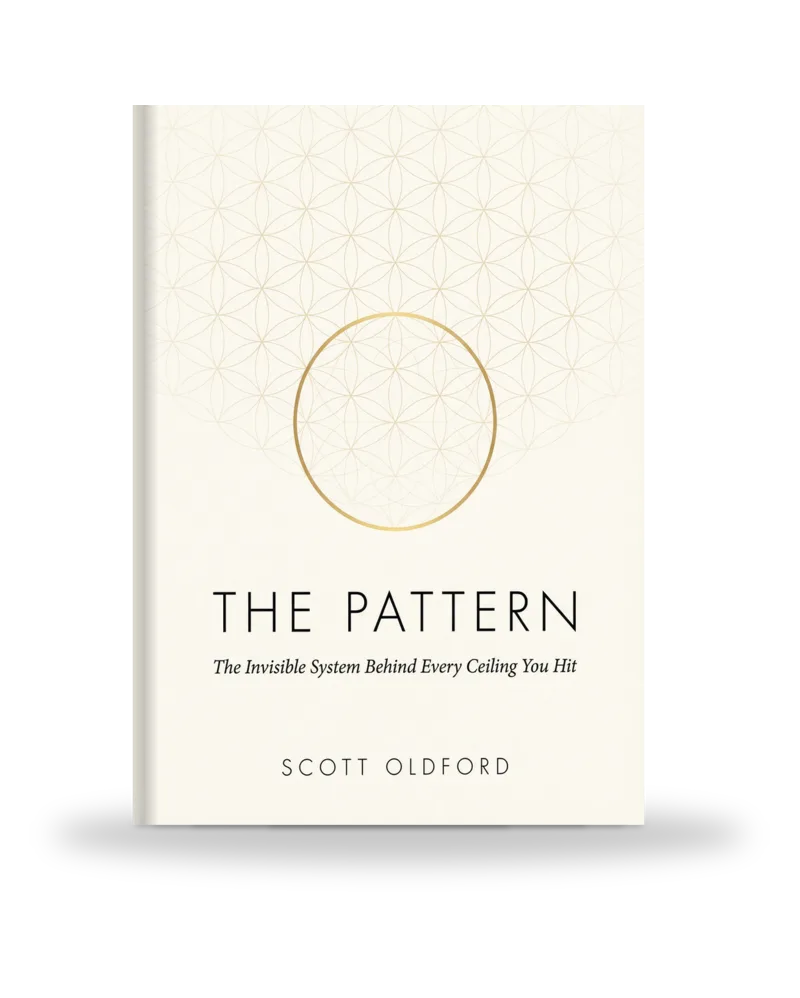
The Pattern is a psychological-diagnostic book for Entrepreneurs who keep hitting the same wall in a new costume. It argues that most plateaus are not strategy problems but a "pattern" problem: an operating system built from how you think under pressure, adaptive at an earlier stage of the business, that becomes the ceiling at the next one without ever announcing the shift. It maps 12 distinct patterns, a 9-pillar diagnostic grid, and the way patterns blend in pairs, drawn from 15 years and 10,000+ Entrepreneurs. It's for anyone rebuilding for the second or third time and noticing the wall looks familiar.
What the book argues
I've spent 15 years working with Entrepreneurs. More than 10,000 people, across every industry, every revenue level, every business model you can name. Solopreneurs at $80K who couldn't figure out why they kept stopping at the same ceiling. Operators at $5 million who were working themselves into the ground and couldn't figure out why more effort kept producing the same result. The pattern connecting almost all of them wasn't a missing tactic. It was something underneath the tactics, running the show without ever being named.
The book's central claim is simple to say and hard to see, which is the whole problem: you can't read the label from inside the bottle. Through your pattern, the world looks like the truth. The strategies look reasonable. The fears look justified. The hiding places look like preferences or values or simply who you are. That's the situation. You're the bottle. Self-awareness alone doesn't fix this, because the pattern generates its own evidence. It confirms itself every time you act from inside it, which is most of the time, which is why it stays invisible for years past the point where it stopped serving you.
### The 12 Patterns
The book names twelve distinct operating patterns: the Overthinking Achiever, the Burned-Out Builder, the Invisible Expert, the Plateau Prisoner, the Control Addict, the Shiny Object Chaser, the Identity Refugee, the Reluctant CEO, the Fear-Driven Grinder, the Energetic Misaligner, the Lonely Operator, and the Threshold Guardian. Each gets its own chapter, and every chapter follows the same structure: the Scene (what it feels like from inside, in second person), the Pattern (the mechanism underneath the feeling), how it shows up across the 9 Pillars, how it blends with a second pattern, and the Shift (one concrete move).
None of these patterns make you broken. You are not the pattern. The pattern is something you've been running. Running is different from being. That distinction matters more than it sounds like it should, because most people who finally see their pattern clearly spend the first hour hating themselves for it, which is exactly the wrong use of the information.
Some patterns show up as visible dysfunction: the Fear-Driven Grinder who can't stop moving because stillness lets the fear catch up, or the Control Addict who's fired four content writers because nobody's version is ever quite right. Others are quieter and more dangerous, and the danger is that they don't look like a problem at all. The Plateau Prisoner has built something real and good and calls it "enough" a little too early, and a little too permanently. The Threshold Guardian can describe the next version of the business in perfect detail and still decelerates every time they get close, not from failure but from something the book calls fear of success, which is harder to talk about because it sounds ungrateful.
### The 9 Pillars
Running underneath the 12 patterns is a second, cross-cutting framework: nine pillars every pattern gets diagnosed against. Five are business pillars: Marketing, Sales, Operations, Delivery, Finance. Two are inner work pillars: Mindset, Personal Development. Two are personal life pillars: Family, Self. The business pillars are where results show up. The inner pillars are where behavior shifts. The personal pillars are where the shift gets sustained. You can optimize the first group forever, and if you're not touching the second and third, you're doing a very sophisticated version of rearranging the surface.
The book's sharpest diagnostic tool comes out of this grid: when something isn't working, ask two questions. First, which pillar is this appearing in? Second, which pillar is this coming from? Those are usually two different answers. A marketing problem is often a Control Addict problem wearing a marketing costume. A sales problem is often a Threshold Guardian problem, showing up as a close rate that won't move no matter how much the process gets refined. The pillar you've been avoiding the longest, the one that feels most like someone else's department, usually holds the most leverage, because that's where the pattern is most defended. Defended means exposed.
### Blends: why fixing the obvious problem doesn't work
Nobody runs one pattern. The book identifies ten common two-pattern blends, and explains the mechanism behind why they form: every Entrepreneur has a primary pattern (the active protection, the behavior that looks like the problem) and a secondary pattern (the underlying fear that made the protection necessary in the first place). The primary tells you what you're doing. The secondary tells you why. Working on the primary without the secondary is cutting the weed at the stem. It comes back. Working on the secondary is going to the root.
One blend gets named directly as the most dangerous combination in the book: the Burned-Out Builder plus the Lonely Operator. Not dangerous because it produces visible crisis. Dangerous because it doesn't. Everything looks fine from the outside while the internal experience is disappearing in place. It doesn't break suddenly. It erodes. A second, the Plateau Prisoner plus the Threshold Guardian, gets called the most insidious, because there's no crisis at all. Nothing is broken. Everything is fine. And fine is exactly where the pattern intends to keep things.
### Where this connects to the other frameworks
Chapter 18 does something most books in this genre don't bother doing: it explains why its own frameworks aren't the final word, and how it hands off to Scott's other named methods. An Entrepreneur learns the R.O.I. Method (Relevancy, Omnipresence, Intimacy) and starts applying it to marketing. They get some results, then stall, because the Omnipresence piece requires showing up consistently and publicly, and the Invisible Expert pattern keeps pulling them back from the edge of visibility. The framework is right. The pattern underneath it is still running. Pattern first. Framework second. The sequence matters, and it's the reason a good framework can fail on a good operator for reasons that have nothing to do with the framework.
The book closes with a three-step method it calls the only three steps that matter: see the pattern, find the pillar, take the action, specifically one irreversible action per week. Reversible actions don't shift patterns, because the pattern knows how to undo them. Irreversible actions create a new reality the pattern has to adjust to. And the pattern, once seen, does not disappear. That's not the goal. The goal is visibility. A visible pattern is a fundamentally different thing than an invisible one.
Why business outcomes are predictable.
From the book: Chapter 14, "Fine." (The Lonely Operator)
From the book
Chapter 14 opens with a scene most Entrepreneurs will recognize before they finish the first line. What follows is the published text, with the book's own pacing marks, elided where the chapter runs longer than this page:
"Your partner asks how the day was. You say 'fine.' Not because nothing happened. Because the real answer would take forty-five minutes, require context they don't have, and even with the context, they couldn't quite hold what it means to be where you are. So you say 'fine.' ... There was a decision made this morning that you've been working toward for months... Nobody around you knows it happened... And somewhere in the quiet, on a Sunday evening, on a night like tonight, there's a particular kind of hollow that you're not sure you've ever named out loud to another person. The loneliness of the top. Which isn't even the top, really. Just high enough that the air is different."
The chapter then does what every pattern chapter in the book does. It names the Scene, defines the Pattern underneath it, walks the nine pillars to show where it's costing you, identifies the common Blend, and ends with the Shift: the specific move that breaks the loop.
Who it's for
This is for the founder on their second or third rebuild, the one who's already been through a collapse and a comeback once, maybe twice, and keeps noticing that the wall they're hitting now has the same shape as the one from three years ago, just wearing better clothes. It's for the operator who's outgrown "hustle harder" as an answer, because they've already proven hustle works, and the ceiling is still there. It's for anyone who's read a strategy book, applied it correctly, and stalled anyway, and suspects the stall isn't about the strategy.
It is not for someone looking for a new tactical framework to bolt onto an existing business. There isn't one in here. It's also not the right starting point for someone who hasn't built anything yet, since most of the 12 patterns describe what happens to a functioning operator under the specific pressure of scale, not the anxieties of starting out. And it's not for someone who wants the diagnosis without the two or three uncomfortable conversations the book asks for at the end of most chapters. The Shift sections are short. They're not easy.
Where it sits in the nine
The origin story behind this book, the accountant's office at 21 with $726,000 in debt, is told in full inside Chapter 1, and it's also the scene I keep coming back to whenever I explain where the ROI Method came from, in the essay on Relevancy, Omnipresence, and Intimacy. If you want the whole fifteen-year arc that scene sits inside, year by year, that's told here, and it's the piece that first pointed me toward this book.
Where to start
Read this after you've already built something and rebuilt it at least once. If you haven't named your own operating framework yet, The Levels of Consciousness is the better starting point, since it maps the four states (Reactive, Willful, Intellectual, Intuitive) that a pattern tends to hide inside, and gives you the vocabulary this book assumes you already have. If you've read The Pattern and want the energetic layer underneath the psychological one, The 33 Energetic Laws picks up where a pattern's mechanism leaves off, in a more transmission-style register. For the full map of how all nine books relate, see the reading order.
FAQ
What is The Pattern about?
It's a book about why Entrepreneurs plateau even when they're doing everything right. It argues the real constraint is usually an invisible operating pattern, not a missing strategy, and it maps 12 of the most common patterns along with a 9-pillar diagnostic for finding where each one lives in a business.
Is The Pattern worth reading if I've already read Scott's other books?
Yes, and it changes how the others land. Chapter 18 directly explains why frameworks like the ROI Method or the 3 Lane Method stall on otherwise capable operators: the framework is correct and the pattern underneath it is still running the show.
Do I need to read another book before this one?
Not strictly. The Levels of Consciousness gives useful groundwork, since the four levels it maps (Reactive, Willful, Intellectual, Intuitive) are the states a pattern typically hides inside.
What are the 12 patterns?
The Overthinking Achiever, the Burned-Out Builder, the Invisible Expert, the Plateau Prisoner, the Control Addict, the Shiny Object Chaser, the Identity Refugee, the Reluctant CEO, the Fear-Driven Grinder, the Energetic Misaligner, the Lonely Operator, and the Threshold Guardian.
Is this a mindset book or a business book?
Both, on purpose. Every pattern gets diagnosed across five business pillars (Marketing, Sales, Operations, Delivery, Finance) and four inner and personal ones (Mindset, Personal Development, Family, Self), because the book's position is that these were never separate problems.
What's the double-dot punctuation in the excerpt?
That's the book's own pacing device, a trailing thought marked with two dots instead of three. It shows up nowhere else in Scott's other books. It's reproduced exactly as written, because the excerpt above is verbatim.
Take the pattern quiz
If the "Fine." scene above landed, the fastest way to find your own pattern is the diagnostic quiz built alongside the book. Read the full 12 patterns, the 9-pillar breakdown, and every chapter's Shift: thepatternmindsetbook.com.
Take the pattern quiz