Book
The 33 Energetic Laws
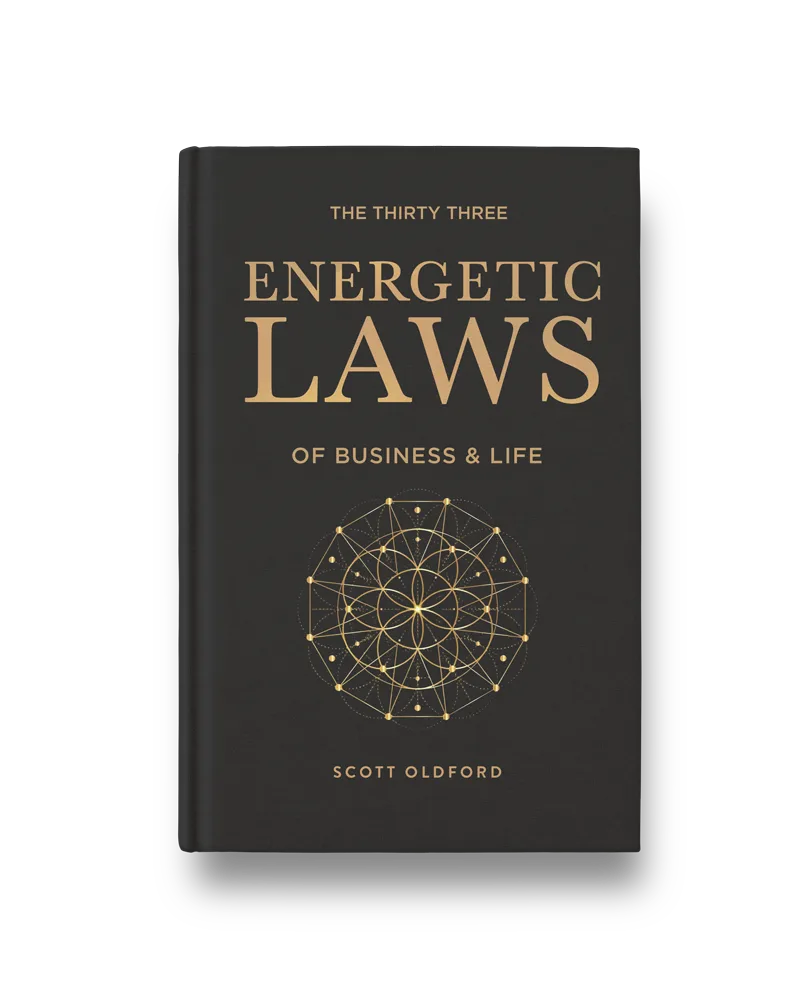
The 33 Energetic Laws is a teaching text, not a business book. It has no stories, no case studies, no funnels. It's 33 short laws, each with the same four-part structure, arguing that your results are downstream of your energetic state, not your tactics. It's for the Entrepreneur whose business works on paper and still doesn't feel like it's working. The Entrepreneur who wants a new marketing plan should start somewhere else.
Say that before anything else, because it's the whole pre-sell: if you open this book expecting frameworks, screenshots, or step-by-step, you'll bounce off it in the first ten pages. It isn't written like Scott's other books. There's no memoir, no debt story, no "here's what I built and how." It's 33 laws, each one a naming, not a proof. If that's not what you're looking for right now, this probably isn't your next read. If it IS what you're looking for, keep going.
What the book argues
The core claim of the book is simple to state and uncomfortable to sit with: your business is a mirror of your energetic state, and no amount of strategy fixes a result that's really an energetic problem.
Scott built the book around a pattern he saw over and over in Entrepreneurs who'd already done the work. They'd built the offer. They'd learnt the funnel. They'd hired the team. And the business still felt heavy, or stuck, or like it was working everyone except them. His answer isn't "try harder" or "optimize more." It's that the strategy layer was never the layer where the problem lived. The energy underneath it was.
That's the frame the whole book operates from: you are the algorithm. Not your funnel, not your content calendar, not your pricing page. You are the source of the strategy, and the state you're building from sets the ceiling on what the strategy can produce. Law 1 opens the book on exactly this point, and it's the thesis every other law is a variation of.
### The structure: four parts, every time
Each of the 33 laws follows the same shape, on purpose, without variation:
1. The law itself: a short, direct statement of the principle, usually one or two lines. 2. The naming: a paragraph or two that names what the reader is experiencing, in language that assumes they already know it and just haven't said it out loud. 3. The inversion: the reframe. What looks like a problem (burnout, a plateau, a client who won't pay on time) gets turned around and shown as a signal instead. 4. The invitation: a closing "Transmission" that distills the law into its most quotable, most repeatable form. Not an action item. An invitation to shift.
There's no proof section anywhere in the book. No case study, no client result, no before/after. That's not an omission. It's the point. The book isn't trying to convince you the laws are true with evidence. It's trying to name something you already sense and let the naming do the work. If you need proof before you'll consider an idea, this book will frustrate you. If a clean naming of something you've felt for months is enough to move you, it'll land hard.
### The territory the 33 laws cover
The laws aren't random. Read together, they move through a handful of connected ideas:
Energy comes before strategy. Law 1 (Frequency First) and Law 33 (Conscious Creation, the closing law) bookend the whole text on this point: your business reflects your current state of consciousness, not just your actions.
Capacity is the real ceiling. Law 3 (Energetic Capacity) makes the case that you don't receive what you desire, you receive what your nervous system can hold without collapsing or leaking. This is the law that explains why some people implode right after a launch works.
Clients and results are a mirror, not a market problem. Law 8 (Energetic Reciprocity) and Law 23 (Reciprocal Resonance) both argue that who shows up in your business reflects your frequency, not your funnel. This is one of the more confronting threads in the book, especially for anyone still blaming lead quality.
Stillness and pause are productive, not lazy. Law 2 (Stillness) and Law 9 (The Sacred Pause) reframe rest as the place clarity is born, not the thing that happens after the real work.
Boundaries and standards are frequency, not walls. Law 18 (Sacred Standards) is one of the sharpest single laws in the book: you don't get what you want, you get what you allow.
Discipline and devotion are different engines. Law 26 draws the contrast directly: discipline says do it or else, devotion says this is who I am. One fades. One endures.
Wealth is five currencies, not one. Law 31 (Wealth in All Forms) is the closest thing in the book to a standalone framework: money, time, energy, relationships, and attention, all treated as currencies you're either receiving or resisting.
None of this is delivered as a system you implement. It's delivered as a set of namings you either recognize in yourself or you don't. That's the whole method.
### A few more laws worth knowing before you buy
A handful of the other 33 come up here because readers ask about them directly. Law 4 (Strategic Surrender) reframes surrender as precision rather than passivity, aimed at anyone who scaled by force and is starting to feel the cost of it. Law 14 (Invisible Leverage) makes the case that real leverage is quiet, felt in clarity and presence rather than in more content or more offers. Law 21 (Non-Linear Growth) exists for the plateau specifically, arguing that most plateaus are invisible expansions rather than failures. Law 28 (Simplicity) is one of the shortest and most quoted: the higher the energy, the fewer the words.
Each of these follows the same four-part shape as the two excerpted below. None of them resolve into a checklist. They resolve into a felt recognition, or they don't, and the book trusts you to know which.
From the book: Law 1, "The Law of Frequency First"
From the book
The following is quoted verbatim from the book, in its original four-part structure. Punctuation and formatting are the book's own.
The Law
"You are the algorithm. You are the source of strategy. And the energy you're in… sets the outcomes you experience."
The Naming
"I can't tell you how many times I've watched someone come to me and say… 'I just need the right funnel.' 'I think I'm missing the steps.' 'Should I launch again or wait?' And I'll ask… 'What energy are you in right now?' Usually, there's a pause. Then a sigh. Then the truth… 'I feel tired.' 'I'm not clear.' 'I feel like I'm chasing.'"
The Inversion
"And in that moment before we touch any tactic I guide them back to the source frequency of their business. Because no matter how intelligent the strategy… if it's built on anxious, misaligned, or fractured energy… it will fracture the result."
The Invitation (The Transmission)
"Your energy is the instruction manual the Universe follows... So if it's not working? Don't start with more strategy. Start with resonance."
From the book: Law 18, "The Law of Sacred Standards"
From the book
The Law
"Boundaries aren't walls — they're invitations to your true frequency."
The Naming
"That client who drains you? You allowed it. That offer that doesn't feel good to deliver anymore? You're still running it. That leaky DM conversation that keeps going nowhere? You keep responding."
The Inversion
"This isn't judgment. This is power. Because when you realize your current experience is not a reflection of your value, but of your standards — you finally get to change the field."
The Invitation (The Transmission)
"You don't get what you want. You get what you allow."
Notice what's absent from both. No data. No client name. No before/after. Just a law, a naming, an inversion, and an invitation. That's the entire book, 33 times.
Who it's for, and who it isn't
This is for the Entrepreneur whose business works and whose energy doesn't. Revenue is fine, maybe better than fine. The team is running. The offer converts. And underneath all of it, something feels off, tight, or hollow, and no new tactic has touched that feeling. This book is written directly at that gap.
It's also for anyone who has already tried the strategy layer, more than once, and knows in their body that another course or another funnel rebuild isn't the thing that's going to move them. If your honest answer to "what's wrong" is closer to "I don't know, I just feel off" than "I need a better offer," this is closer to being your book.
It's not for someone looking for tactics, scripts, or a step-by-step plan. There isn't one in here. Someone who needs evidence before they'll consider an idea will fight every page. The book doesn't argue its case with proof, it names things and lets you decide if they land. And it's not the place to start if you've never read anything from Scott before. Without the strategic grounding of his other work, the laws can read as vague rather than precise. Read this after you've already tested the tactical layer and found it insufficient, not instead of testing it.
If you're mid-scale and just need clearer positioning, better sales copy, or a tighter operational system, there are better books in this catalog for that moment. Come back here when the thing that's stuck isn't the system anymore.
A practical way to check which side of that line you're on: try to name, in one sentence, what's wrong with your business right now. If the sentence names a system ("my funnel converts at half the rate it should" or "my offer isn't priced right"), start with a tactical book. If the sentence names a state ("I don't trust myself to make decisions anymore" or "I've stopped believing my own marketing"), this book is speaking directly to you. Some readers find both are true at once. That's fine. Read this one first, then go fix the funnel from a steadier place.
Where it sits in the nine
If you want a diagnosis, read The Pattern first. If you want a structured model you can apply across your whole business, read The Levels of Consciousness. If you just need something to name what you're already sensing, without a diagnosis or a framework attached to it, start here. There's no required order among the three. Full sequencing across all nine books lives on the reading order page.
Where to start
This book sits in the inner-work lane, alongside The Pattern and The Levels of Consciousness. All three are about what's happening underneath the business rather than inside it, but they approach it differently. The Pattern is diagnostic: it names twelve specific patterns Entrepreneurs run and shows you which one is yours. The Levels of Consciousness is a framework: it maps four levels of consciousness and applies them across every domain of the business, from marketing to finance. The 33 Energetic Laws is neither diagnostic nor a framework. It's a transmission. It doesn't tell you which pattern you're running or which level you're operating from. It just names 33 truths and lets you sit with which ones are true for you right now.
FAQ
What is The 33 Energetic Laws about?
It's 33 short laws arguing that business results follow the Entrepreneur's energetic state, not their strategy. Each law has the same four-part structure: the law itself, a naming of what you're experiencing, an inversion that reframes it, and a closing invitation. There are no stories or case studies in the book.
Is The 33 Energetic Laws worth reading?
It depends entirely on what you need right now. If you're looking for tactics or proof-based arguments, it won't feel worth it. If you're looking for a clean naming of something you've been feeling but haven't said out loud, most readers find it's the fastest read in the catalog that still lands hard.
Do I need to read anything before this one?
Not strictly. It helps, though. The laws are precise, not vague, if you've already tested the tactical layer of business and found it insufficient. If you haven't, the same lines can read as abstract rather than exact.
Is this a business book?
Not in the traditional sense. It has no funnels, no scripts, no case studies. It applies to business because Scott built it from watching Entrepreneurs specifically, but the laws themselves are about energy and consciousness, not tactics.
How long is it and how is it structured?
It's built as 33 short, self-contained laws, each following the same four-part shape (law, naming, inversion, invitation/"Transmission"). You can read one law in a couple of minutes or the whole book in a sitting.
What's the difference between this and The Pattern or The Levels of Consciousness?
The Pattern diagnoses which of twelve specific patterns you're running. The Levels of Consciousness maps four levels of consciousness across every business domain. The 33 Energetic Laws does neither. It names 33 truths without diagnosing or building a model, and leaves the application to you.
If the excerpts above named something you've been circling for a while, that's the whole book, 33 more times: get your copy here.
Read the book
The 33 Energetic Laws is available at the33energeticlaws.com.
Read The 33 Energetic Laws