Book
Resonance
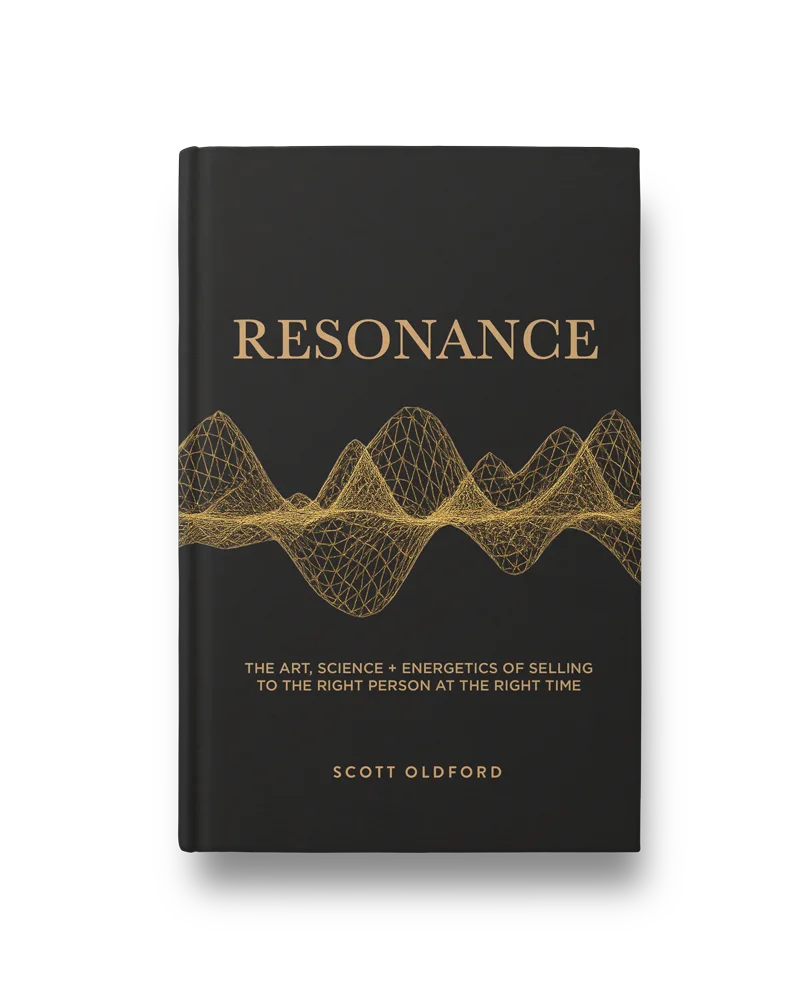
Resonance is Scott Oldford's book on why marketing that looks fine on paper still doesn't convert. The argument: most content and offers are relevant but don't resonate, so they get seen without ever being felt. It teaches the 3 Lane Method, the five parts of resonance, and why the strongest sales process is self-persuasion, not persuasion. Written for Entrepreneurs whose marketing is technically correct and still not working, without anyone able to say why.
What the book argues
Most marketing advice assumes the problem is skill. Write a better hook. Fix the funnel. Post more. Resonance opens by rejecting that assumption. The book's actual claim is that marketing which fails to convert is usually not wrong, it's early. It's landing on someone who isn't in a state to receive it, delivered with an energy that reads as pressure instead of truth.
The book's spine is the 3 Lane Method: the Sidewalk, the Slow Lane, and the Fast Lane. The Sidewalk holds people who haven't named their problem yet. The Slow Lane holds people who know they have a problem and are actively looking, but haven't decided you're the one to solve it. The Fast Lane holds people who've already done the thinking and are ready to move. Scott cites the researcher Chet Holmes, who found that at any moment, roughly 3 percent of a market is ready to buy, 7 percent is open but not searching, and the remaining 90 percent is somewhere between unaware and indifferent. Most marketing is written for the 3 percent and ignores the other 97, then wonders why nothing converts.
The 3 Lane Method gets its full teaching treatment on the sibling framework page, /frameworks/3-lane-method. What this book adds underneath the lanes is the deeper layer: why speaking to someone before they're ready doesn't just fail to convert them, it actively pushes them away. The book names three specific reasons a too-early message backfires. Cognitive dissonance, where a bold offer to solve a problem someone hasn't fully named yet feels threatening rather than exciting, because the subconscious reads it as "I don't have the identity to hold this yet." Information overload, because the average brain is already processing an estimated 74 gigabytes of data a day before your email, your video, or your pitch ever reaches it. And reactance, the well-documented psychological effect where perceiving pressure on your freedom to choose makes you push back, even against an outcome you want. Put together, the book's real diagnosis for most "my marketing isn't converting" complaints rarely comes down to the offer, the price, or the branding. Usually the message arrived before the person was ready to receive it.
From there the book builds its central distinction, and this is the one that gives the book its title. Relevancy is the intellectual case: does your message describe this person's actual situation. Resonance is the emotional and energetic case: does this person feel safe with you, understood by you, like you see the world the way they do. The ROI Method teaches the full sequence Relevancy builds on, but Resonance is where the emotional half gets its own treatment, because a message can be perfectly relevant and still fail to move anyone if the felt sense of safety isn't there underneath it.
Resonance itself, the book argues, breaks into five parts, and each is a specific place marketing fails without ever announcing it.
Similar energy and belief systems. When someone encounters a message that matches how they already see the world, their nervous system reads it as safe before their conscious mind has evaluated anything. That's a physiological event, not a rapport trick.
Never persuade. Let people self-persuade. The moment someone senses they're being moved, resistance goes up, and that resistance is physiological before it's intellectual, a nervous system checking whether it's being sold to.
Invitation rather than manipulation. The same information, offered as an open door instead of a closing one, gets received differently. Manufactured urgency and genuine urgency produce different physiological responses even when the words are similar, and people register the difference even when they can't name it.
Truth rather than performance. Performed authenticity is worse than plain professionalism, because it triggers the exact suspicion it's trying to avoid. People can feel the seam between a real position and a rehearsed one.
The absence of fight-or-flight. If your marketing puts someone into a defensive state, nothing that follows lands, no matter how correct it is. This is the one most people skip, because it's the hardest to see from inside your own copy.
Most content advice is additive: more hooks, more urgency, more pattern interrupts. A meaningful amount of the work in this book is subtractive. Less about what to add to your marketing to make it land, more about what to remove so it stops triggering the defense that keeps it from landing at all.
The book's other major contribution is a distinction between signal and noise. Noise is loud, urgent, and performs certainty. Signal is quiet, coherent, and simply is what it says it is. A CTA from noise says "Let's go, don't miss out, time is running out." A CTA from signal says "Here's what's available, you'll know when it's time, I'm here when you are." The claim is narrower than that: urgency invented for a deadline that doesn't exist reads as noise, and noise trains an audience to distrust everything you say next.
From the book: Chapter 3, "Self-Persuasion Is More Powerful Than Sales Pressure"
From the book
The published text, elided where the chapter runs longer than this page:
"The most effective sales process isn't a pitch. It's a mirror. It's not about pushing someone into a decision. It's about reflecting the part of them that already knows it's time... When they hear their own thoughts echoed in your copy… When they read your story and feel their own timeline light up… When your post names the pain they've never been able to articulate… They don't feel manipulated. They feel met. They don't feel sold. They feel seen."
On why pressure produces refunds instead of customers:
"Contrast that with pressure-based sales: The buyer feels coerced... Even if they say yes… they often second-guess it. Refund rates rise. Buyer's remorse kicks in. Retention drops. That's not conversion. That's compliance."
And the wiring underneath it:
"Mirror neurons fire... Oxytocin (the trust and bonding chemical) rises... The amygdala (your brain's fear and threat center) starts to calm down... The prefrontal cortex... switches on. Only when someone feels safe can they move forward with clarity."
Safety first, decision second. The rest of the chapter builds the practical version: how to write copy that reflects instead of pushes, and how to tell which one you're doing.
Who this book is for
Resonance is for anyone whose marketing is technically fine and still not converting. If you've been told your positioning is clear, your content is consistent, and your offer is solid, and none of that has translated into revenue, this book is naming the layer underneath all three: whether the way you're showing up is triggering safety or triggering a threat response nobody can see from inside your own copy.
It's especially useful for anyone whose instinct, when something doesn't convert, is to add more urgency, more pressure, more frequency. This book argues that instinct is usually backward. It's also the right read for anyone who has watched a warm, engaged audience never quite become paying clients, because that's often a resonance failure wearing a relevancy costume: people who feel safe with you and have never been given a clear enough reason to act.
This isn't the book for someone who wants tactical scripts for cold outreach or a swipe file of high-converting subject lines. It teaches the psychology and the framework underneath those tactics, not the tactics themselves. If you already understand why pressure backfires and just want the mechanics of building a funnel by lane, /frameworks/3-lane-method is the faster read. And if your actual gap is that people don't see your content often enough in the first place, that's a different problem this book doesn't try to solve. Why Your Marketing Feels Invisible walks through that diagnosis directly.
Where it sits in the nine
Where to start
Read The Nuclear Effect first if you want the widest-lens introduction to how Scott builds a business, since Resonance assumes you already accept that marketing is more than tactics. Resonance itself hands off directly into The ROI Method: the book's own closing chapters introduce Relevancy, Omnipresence, and Intimacy as the next layer, and are explicit that the fuller teaching of that framework lives elsewhere. Read The 3 Lane Method alongside or after this one. It's the same lane framework this book introduces, expanded into a full operational build across content, email, funnels, offers, and sales process. The general reading order for all nine books lives at /books/reading-order.
Reader proof
"Scott showed me how to stop doing sales meetings and scale from $30k to $70k months." Joella Skoogh, Business & Marketing Mentor
That result is the self-persuasion thesis in practice. A sales meeting is a live persuasion attempt, one person trying to move another in real time. Removing it and still scaling only works if the marketing beforehand has already done what a sales call used to do: build enough resonance that the person arrives having already decided, rather than needing to be convinced on the call.
Beyond the individual result, Resonance sits inside nine books with more than 250,000 copies in circulation, from an author who's spent 15 years building marketing systems for 10,000+ Entrepreneurs generating over $1B in collective client revenue.
Frequently asked questions
What is Resonance by Scott Oldford about?
It's a book about why marketing that looks correct on paper still fails to convert, and the psychological reason people buy when they feel safe and self-persuade, rather than when they're pushed. It teaches the 3 Lane Method and the five parts of resonance underneath it.
Is Resonance worth reading if I already know the 3 Lane Method?
Yes, if what you're after is the psychology underneath the lanes rather than the operational build. This book goes deeper into cognitive dissonance, reactance, and self-persuasion than the framework page does. If you want the operational version instead, /frameworks/3-lane-method covers that.
Do I need to read The Nuclear Effect before Resonance?
No, but it helps. Resonance assumes you're already past the idea that marketing is just tactics. The Nuclear Effect is the wider introduction to Scott's overall approach, and Resonance goes deep on one specific layer of it.
What's the difference between relevancy and resonance?
Relevancy is the intellectual case, whether your message accurately describes someone's real situation. Resonance is the emotional and energetic case, whether that person feels safe enough with you to act on it. This book is the deep teaching on the second half. The ROI Method covers where relevancy fits into the full three-part framework.
Why does the book say self-persuasion works better than a sales pitch?
Because pressure-based sales get compliance, not conviction. The book's own language: buyers who are pushed into a yes often second-guess it afterward, refund rates rise, and retention drops. Self-persuasion produces a decision the buyer experiences as their own, which holds up after the sale in a way a pushed decision doesn't.
Is this a sales book or a marketing book?
Both, and the book treats that split as artificial. Its position is that marketing and sales are the same energetic event at different distances, and the same resonance-versus-noise problem shows up in a funnel, an email, and a sales call alike.
Read the full book at theresonancebook.com.
Go deeper
Resonance is one part of a bigger system. Get the framework in full, taught for a broader marketing and sales context, at /frameworks/roi-method, or read the full operational build of the lane framework this book introduces at /books/3-lane-method.
Read Resonance