Book
The Nuclear Effect
The book everything else I teach eventually connects back to.
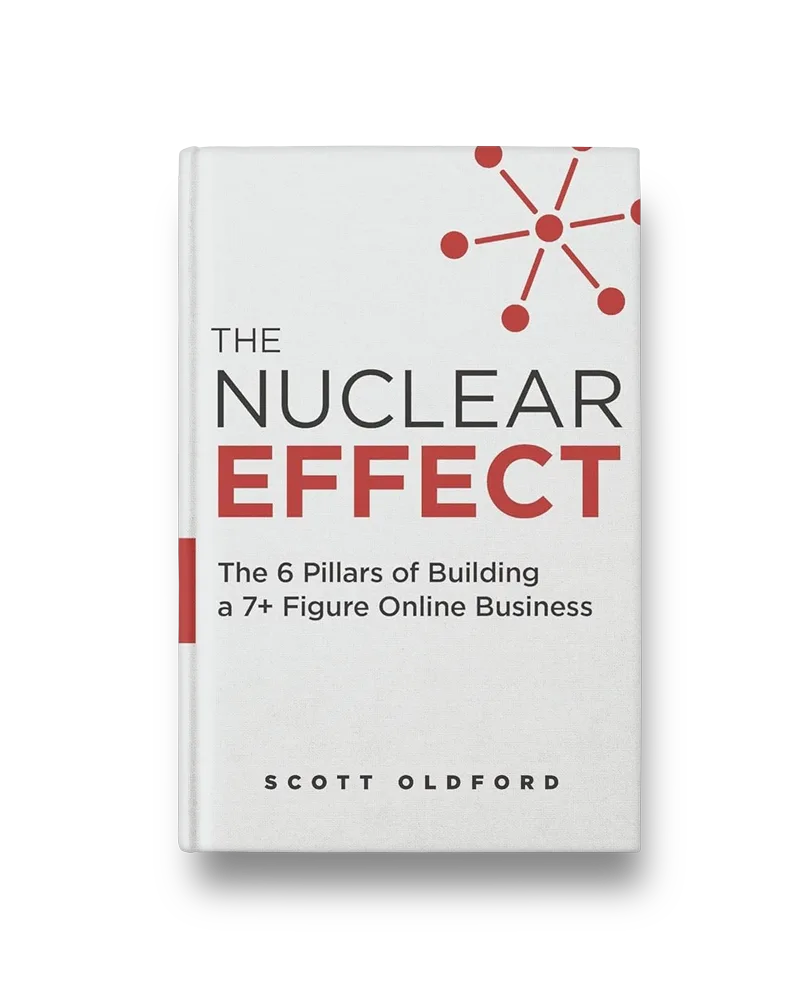
The Nuclear Effect is my flagship book: a Six Pillars operating system, Marketing, Sales, Operations, Delivery, Finance, and Mindset, for building a business that compounds instead of one that needs constant force. Over 100,000 Entrepreneurs have a copy. It's for established or scaling online business owners, roughly $15K a month and up, who need both the tactical systems and the internal work underneath them, though the early chapters speak directly to Entrepreneurs below that line too. Published by Lioncrest in 2020, it's the book everything else I teach eventually connects back to.
If you want the framework itself taught as a standalone tool, with the six-question audit and the diagnostic for finding your actual weak pillar, that lives on a separate page: The 6 Pillars. This page is about the book. The framework page is about using the framework. Read this one for the thinking and the stories underneath it. Read that one when you're ready to run the audit on your own business.
What the Book Argues
The core idea in the title is simple to say and easy to underestimate. A nuclear reaction doesn't start with one enormous event. It starts with a small reaction that produces just enough extra energy to trigger the next one, and the next, until the whole thing is self-sustaining. I built the book around the belief that businesses work the same way. Small, aligned improvements across six specific areas compound into growth that stops requiring force, and most businesses never get there because they keep pouring effort into one pillar while the other five rot without anyone noticing.
The six pillars are Marketing, Sales, Operations, Delivery, Finance, and Mindset. Every business, including a business of one with no team yet, stands on all six whether anyone built them on purpose or not. The book's central diagnostic claim, and the one I still watch Entrepreneurs get wrong most often, is that the pillar where a problem shows up as a symptom is rarely the pillar that's the real break. Falling sales get treated as a sales problem and someone hires a closer. Often the real cause is sitting in Delivery, where churn has been killing referrals for months without anyone tracing it back, or in Mindset, where the offer stopped being sold with real conviction months ago. The closer never had a chance, because nobody traced the symptom backward before spending money on it.
What the book stands on
Every business stands on all six, built on purpose or not.
The pillar where a problem shows up as a symptom is rarely the pillar that's the real break.
Marketing, in the book, runs through what I call the R.O.I. Method: Relevancy, Omnipresence, Intimacy. Not return on investment. Relevancy is being positioned as the obvious choice for a specific person's specific problem, built through your Unfair Advantage, your method, and your story. Omnipresence is being seen enough, by the same people, consistently, that you start to feel inevitable to them rather than lucky to have found once. Intimacy is the trust that removes the need to sell at all, because business happens at the speed of trust and that's not a soft principle, it's a hard economic reality. I discovered Omnipresence by accident in 2016, boosting my own content because I couldn't afford an agency, and a few months later a client offered me a $25,000-a-month consulting rate I hadn't even asked for. I'd accidentally become famous inside my own bubble.
Sales gets taught through the 4-Step Close, a method built on curiosity instead of pressure: illuminate the person's actual pain, help them visualize the goal clearly, highlight the gap between where they are and where they want to be, then create the commitment. That sequence, taught to me by a mentor, took me to nearly $20 million in personal sales. The book also lists six actual reasons a qualified person doesn't buy, and only one of them has anything to do with your closing technique. The offer wasn't relevant to them. They don't believe their own pain is real. They weren't your true buyer. They don't trust your method. They don't see you as enough of an authority. Or they don't believe in themselves enough to commit. A better script fixes almost none of those.
Delivery is the pillar I spend real time renaming in the book, because most Entrepreneurs think of it as "the product," and that's already the mistake. The product is the promise. The delivery is the proof. Everything said in the marketing and the sales conversation either gets confirmed or contradicted in what happens after the money changes hands. Two ideas do the heavy lifting here: sell what they want, deliver what they need, since what a client asks for and what would help them most are usually different things, and the 12:12:3 Customer Success Map, which maps a client's life at 12 weeks, 12 months, and 2 to 3 years out. Most businesses only ever design for the first twelve weeks and then wonder why nobody stays.
Operations is the pillar that turns a business into a business instead of a job with better branding, and I learnt its cost the expensive way, more than once. Finance in the book is not the bank balance. It's whether you know, specifically, where every dollar is going and what it's funding, and it's the pillar underneath my most expensive lesson: I lost more than ten million dollars building a portfolio of companies after a period of massive growth, having already taught the principle in seminars that if you scale a loss, you'll only lose more. I scaled several losing businesses anyway. I was gambling. I just didn't know it at the time.
Mindset closes the book, and it's the pillar most Entrepreneurs treat as soft right up until they notice it's been setting the ceiling on every decision above it the whole time. Every choice inside the other five pillars runs through the same nervous system, and if that system is operating from scarcity, every pillar inherits the scarcity whether the numbers show it yet or not. This is also where the book gets most personal: the weight loss from 360 pounds to 170, the panic attack at 50,000 email subscribers, the therapist's question about why I loved myself, and the second half of the $10M story, the part about what losing that money did to my sense of identity rather than just my balance sheet. "The real nuclear effect isn't just in your business," I write in the conclusion. "It's in you."
The full Go Nuclear training.
From the book: "The Story I Tell When I Need to Remind Myself"
From the book
Chapter 2 carries the rebuild story that the whole book leans on. The published text, elided where the chapter runs longer than this page:
"I ended up with about $3,000 to my name, a ton of hard-won experience that nobody currently wanted to pay me for, and a choice to make...
I booked meetings. Hundreds of them... Over 200 meetings in a short window of time. And in every single one, I followed the same simple process. First, I asked them where they were and where they wanted to go... Second, I helped them get clear on the gap... Third, I showed them what a better future could look like... Fourth, I showed them how I could help them get there... Fifth... I told them about my own situation...
The result? About $250,000 in contracts within 60 days... Our mantra was three words: We get shit done."
Two hundred conversations before there was a method. The method came from paying attention to what worked inside them. That order, conversations first and systems second, is the same order the six pillars get built in, and the book returns to it in every chapter that follows.
Who This Book Is For
This is for online business owners who already have some traction and are feeling the specific frustration of working harder without the business getting proportionally easier. If you're past $15K a month and growth has started to feel like force instead of momentum, this book is built for exactly that moment. It's also for Entrepreneurs who sense that their actual constraint might not be where the pain is showing up, and want a structured way to check.
It's for people willing to read a business book that spends real pages on weight loss, panic attacks, and a $10 million financial loss, because the argument of the book is that Mindset is a pillar with the same structural weight as Finance or Operations, not a bonus chapter tacked on at the end.
Who Shouldn't Start Here
If you're pre-revenue or making your first few sales, this isn't the place to begin. The book assumes you already have a business generating some income and speaks to the specific problems of scaling one, not starting one. You'll get more from Read This If You're Scaling at that stage, or from working the R.O.I. Method piece by piece before you tackle all six pillars at once.
If you're looking for a pure tactics manual with no internal work in it, you'll find the Mindset chapter frustrating. That's intentional on my part, but it's fair to know going in.
If you've already read this book closely and worked the audit, you don't need to reread it. You need the 3 Lane Method or Human First for the layers this book only touches.
Where It Sits in the Nine
The Nuclear Effect is the widest-lens book of the nine, which is why I usually point people here first. If you want the internal work underneath Mindset specifically, read The Levels of Consciousness next, since it goes deeper into how the person making the decisions changes over time. If you want the Marketing pillar taken further, The 3 Lane Method is the direct expansion. If the Finance chapter's $10M story is the one that stuck with you, Million in the Red picks up that thread in full. For the complete map of what to read first, see the reading order.
Where to start
The Levels of Consciousness
the internal work underneath Mindset
The 3 Lane Method
the Marketing pillar taken further
Million in the Red
the $10M thread picked up in full
The widest-lens book of the nine, which is why I usually point people here first.
Reader Proof
"After 5 years I was stuck on the hamster wheel making just enough to cover expenses, Scott helped me 4X my coaching business."
Matt's result maps directly to what this book is for. Breaking the ceiling on a business that's already running and stuck, not starting one from zero.
The 4 phases of going nuclear.
FAQ
What is The Nuclear Effect about?
It's Scott Oldford's book on the Six Pillars, Marketing, Sales, Operations, Delivery, Finance, and Mindset, and the argument that small, aligned improvements across all six compound into growth that stops requiring constant force. Over 100,000 Entrepreneurs have a copy.
Is The Nuclear Effect worth reading?
If you're running an online business past roughly $15K a month and growth has started to feel like force instead of momentum, yes. It's built to help you find which of the six pillars is your real constraint, rather than the one that's loudest.
Do I need to read another book before this one?
No. This is the widest-lens book of the nine and the one most people start with. If you're pre-revenue, Read This If You're Scaling is a better first stop.
What's the difference between this page and the 6 Pillars framework page?
This page is about the book itself: the thesis, the stories, and an excerpt from it. The 6 Pillars page is the framework pulled out on its own, with a full diagnostic audit you can run on your business right now.
Is The Nuclear Effect just theory or is it practical?
Both, on purpose. Each pillar comes with a named framework, the R.O.I. Method for Marketing, the 4-Step Close for Sales, the 12:12:3 map for Delivery, and worked examples, but the book also argues that tactics fail without the Mindset work underneath them, so it doesn't separate the two.
What edition should I read?
The original was published by Lioncrest in 2020. Get the current edition at thenucleareffect.com.
Get the Book
The excerpt above is one chapter of ten. Get The Nuclear Effect at thenucleareffect.com for the full Six Pillars system, every framework, and the complete Mindset chapter this page only summarizes.
Get The Nuclear Effect