Book
Human First
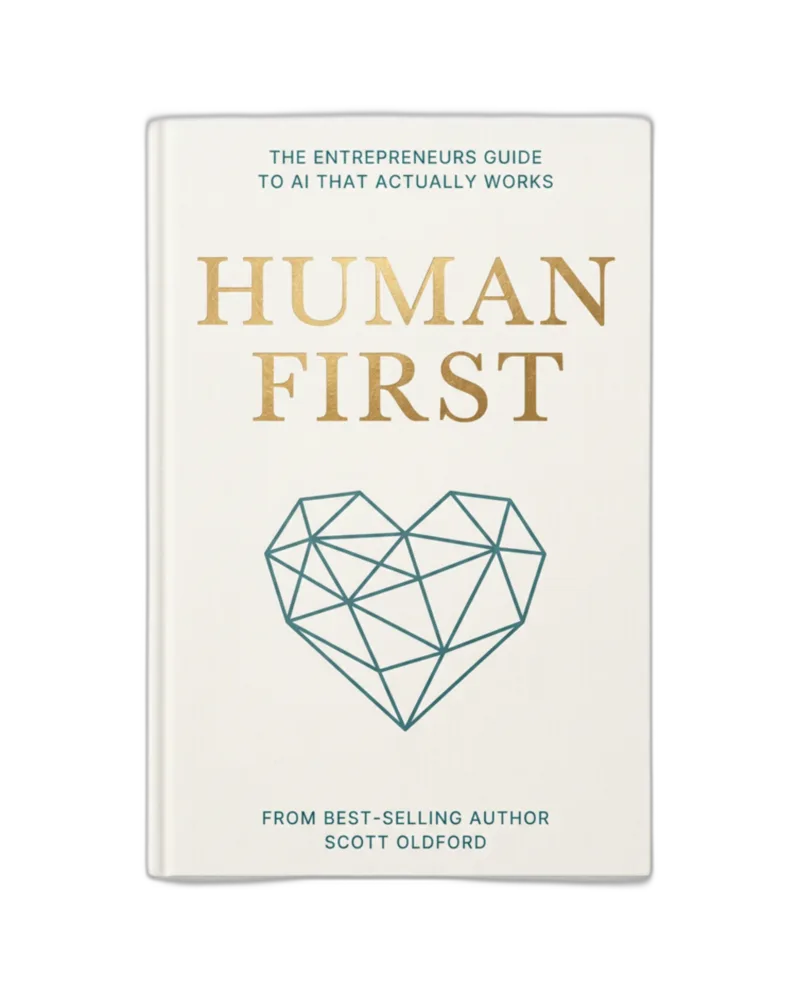
Human First is Scott Oldford's book on where AI belongs in a business and where it never should. Its core claim: every business runs on Three Forces, Intelligence, Consciousness, and Energetics, and AI only ever occupies Intelligence. Written during the months in late 2025 when illness forced Scott out of his own business, it argues the businesses that win in an AI-saturated market aren't the most technical. They're the ones that know exactly where their Intimacy Threshold sits, and protect it on purpose. It's for Entrepreneurs at any revenue stage trying to decide what to automate and what to leave alone.
Scott wrote it in the stretch of 2025 he couldn't work, the same months he wrote about in the origin essay. This is the fuller account. The essay tells you what happened. This book tells you what he built from it.
What the book argues
Most AI advice starts with tools. Human First starts with a diagnosis, and it's a personal one before it's a business one.
At the end of 2025, Scott got sick. Months in bed, stillness he didn't choose and couldn't avoid. Lying there, he watched his own business, the one he'd spent fifteen years building and teaching other people how to build, fail to run without him. Not because it lacked good people or good intentions. Because the intelligence layer, the actual documented systems and frameworks, had gone by the wayside while he focused his own mentorship on consciousness and energetics. He'd been teaching the inner game. He'd neglected his own outer game.
That gap has a name in the book: the Three Forces. Every business runs on Intelligence (strategy, systems, frameworks, the how), Consciousness (awareness, presence, self-knowledge, the why), and Energetics (alignment, embodiment, the felt experience, the who). AI is straight Intelligence. It has zero Consciousness and zero Energetics. That single sentence is the spine the rest of the book hangs from. The book is about which of the three forces a given task belongs to, and what happens when you get that placement wrong.
The wrong question. Scott opens the book naming the anxiety directly: everyone feels behind, every platform is telling you to move faster, and the natural response is to start buying tools. He tells the story of an Entrepreneur who signed up for eleven different AI tools in three months, spending close to two thousand dollars a month, and when asked what had changed in the business, revenue, client outcomes, his own capacity, went quiet. Nothing had changed. More tools, more logins, more complexity. Not transformation. Accumulation. The fix is architecture first, tools second, always in that order.
Document. Simplify. Then automate. This is the book's operational sequence, and it's non-negotiable in the order it comes in. AI can't automate what isn't documented, so skipping to automation just automates your own confusion faster. Simplify before automating, because most processes living in a founder's head carry steps nobody needed anymore. Automate last, and only once the first two are honest. Skip the sequence and you get what Scott calls sophisticated failure: everything built well, none of it mattering, the engineering impressive and the outcomes invisible.
The Intimacy Threshold. This is the book's most fully developed framework, and its central diagnostic tool. It marks the exact line where a task crosses from Intelligence territory, where AI creates leverage, into Consciousness and Energetics territory, where AI creates damage. Below the line: follow-up sequences, reporting, scheduling, first drafts. Above it: the sales conversation for a $25,000 mentorship, the intake call for a vulnerable client, the community check-in that's really relationship wearing a task's clothing. The line sits in a different place for every business, which is why the book gives you four questions instead of a rule of thumb: does this function require reading emotional subtext, would the other person feel betrayed to learn it was AI, does it build or maintain a core relationship, could a mistake here cause irreversible harm. Yes to any one of those, and the function needs a human as the primary decision-maker, not a backup.
You can't automate intimacy without destroying it. The book returns to this line from several angles, each with a real number attached. A group coach who let AI write her community check-ins saved two hours a week and watched engagement drop thirty percent in three months. A $40,000 coach whose gift was hearing what clients weren't saying spent months and tens of thousands of dollars building an AI version of her program, and it failed, because the part that made her work work was her. A client recovered $47,000 in sixty days by letting AI handle follow-up, the one place in the book where automation is unambiguously the right call, because follow-up was never the relationship. It was the mechanics around the relationship.
The Paradox. The book's clearest economic argument: AI makes Intelligence nearly free, and when something becomes nearly free, whatever remains scarce becomes exponentially more valuable. Intelligence becomes the price of entry, table stakes, the thing everyone has because AI makes it affordable. Consciousness becomes the first premium. Energetics becomes the ultimate premium. This is why the book frames protecting the human forces as a business strategy, not a values statement. Not because Intimacy is virtuous. Because it's about to be the only thing left that doesn't commoditize.
Where the frameworks connect. Human First pulls together a decade of Scott's other frameworks and applies each one to the AI decision specifically: the ROI Method (Relevancy, Omnipresence, Intimacy, and why AI amplifies the first two and should never touch the third), the SSF Method or 3 Lane Method (Sidewalk, Slow Lane, Fast Lane, and how AI's role shrinks as the audience gets warmer), the Six Pillars (Marketing, Sales, Product, Operations, Finance, Mindset, mapped for what AI carries in each), and Five Levels of the AI Mind (Primal, Reactive, Willful, Intellectual, Intuitive, because your own consciousness level predicts how you'll implement any of this, regardless of what the book tells you to do). The book also introduces two frameworks that are new here: an eight-archetype diagnostic across four revenue tiers, from Early Explorer through IP Product Builder, and a seven-step Hierarchy of Readiness that ties the whole system into one ordered sequence. Skip a step in that hierarchy, the book argues, and the whole thing breaks. Most people want to start at step seven, the roadmap, without the foundation underneath it. It never works.
The final chapters turn the lens back on the reader. Every automation decision is a statement about what you value. Every boundary you draw around AI is a declaration of what you believe is sacred. The book's closing question isn't about AI at all: what kind of business are you building, and what kind of human do you need to become to build it. AI doesn't answer that. AI can't.
From the book: Chapter 16, "Sacred Ground"
From the book
Chapter 16 draws the lines that the rest of the book builds toward: the places where automation is banned outright, no matter how good the tools get. The published text, elided where the chapter runs longer than this page:
"Trauma and deep emotional processing... AI is not your helper here. It's a liability wrapped in convenience... Vulnerable populations... you don't hand that interaction to a machine... Legal decisions with significant consequences... Financial decisions with irreversible impact... Safety-dependent contexts... You know what all of these have in common? They require presence."
Five zones, one common denominator. The chapter spends its remaining pages on each zone in turn, and on how to tell when a situation that looks routine has quietly crossed into one of them.
Who it's for, and who it isn't
Human First is for Entrepreneurs actively deciding where AI belongs in their business right now, not Entrepreneurs looking for a list of tools to install this afternoon. It's for coaches, consultants, service providers, and course creators who feel the pressure to automate and can't tell if the pressure is real or manufactured. It's especially for anyone running a high-trust, high-touch business, coaching, therapy-adjacent work, done-for-you services, where the temptation to automate the relationship itself is strongest and the cost of getting it wrong is highest.
It is not for someone who wants a tool comparison or a list of the best AI software this quarter. The book barely names specific products, on purpose, because tools change monthly and the book was written to outlast that churn. It's also not the right starting point if you haven't documented a single process in your business yet. The book assumes you're past the very beginning and are now making real decisions about a business with actual clients and actual revenue at stake. If you're pre-revenue, Read This If You're Scaling is the better first stop.
Where it sits in the nine
This book also lives on three other pages on this site, each pulling a different practical thread out of it. What Are Scaling Agents? builds the document-simplify-automate sequence into an actual framework for installing AI agents. How to Scale an Online Business With AI maps what AI should carry across each of the Six Pillars. AI Margin Compression takes the book's Paradox argument and applies it to what happens to your pricing once your buyers have the same AI you do. If you've read any of those three, this page is where the underlying book lives.
Where to start
Read The Nuclear Effect or Read This If You're Scaling first if you haven't built the underlying business frameworks yet. The Six Pillars and the ROI Method, both used throughout Human First, come from that earlier work, and Human First assumes you already have some version of them in place. Read The Levels of Consciousness alongside or after it, since the Five Levels of the AI Mind framework in Human First is a direct application of that consciousness-levels lens to AI decisions specifically. After Human First, The Pattern picks up the identity-level questions the closing chapters raise about who you have to become to build what you're building. For the full sequence, see the reading order.
Reader proof
"We paid off six figures in debt and grew a successful business without compromising time with my children." - Yummii Nguyen, The Motherhood Mindset
That result sits close to what Human First is arguing: growth that doesn't cost you the parts of your life or your business that were never meant to scale.
FAQ
What is Human First by Scott Oldford about?
It's a book about where AI belongs in a business and where it never should. Its core argument is that every business runs on Three Forces, Intelligence, Consciousness, and Energetics, and that AI only ever occupies the first one. Scott wrote it during the months in late 2025 he couldn't work due to illness, after discovering his own business hadn't been built to run without him.
What is the Intimacy Threshold in Human First?
It's the book's central diagnostic: the exact line where a task moves from Intelligence territory, where AI creates leverage, into Consciousness or Energetics territory, where AI creates damage. The book gives four questions to find that line in your own business rather than a fixed rule, because the line sits in a different place for every business and every price point.
Is Human First worth reading if I already use AI in my business?
Yes, and it's especially useful if you already do, because the book isn't arguing against AI. Scott uses it constantly in his own business. It's arguing for knowing exactly which parts of your business to hand to it and which parts to protect, which matters more once you're already using it broadly than before you've started.
Do I need to read Scott Oldford's other books before Human First?
No, though it helps. Human First applies the ROI Method, the Six Pillars, and the Levels of Consciousness framework throughout, all developed in his earlier books. Reading The Nuclear Effect or The Levels of Consciousness first gives you the underlying frameworks Human First assumes you already have.
What does "Document, Simplify, Automate" mean in Human First?
It's the book's non-negotiable order of operations for implementing AI. Document the process as it runs today. Simplify it by cutting steps that only exist out of habit. Automate last, only once the first two are honest. Reversing the order, automating first, produces what the book calls sophisticated failure: an impressive system that accomplishes nothing.
Where can I buy Human First?
Get the book
Human First lays out the full Three Forces framework, the Intimacy Threshold, and the Document-Simplify-Automate sequence in complete detail, along with the stories behind each one. Read it at thehumanfirstbook.com.
Get Human First