Book
Divine Madness
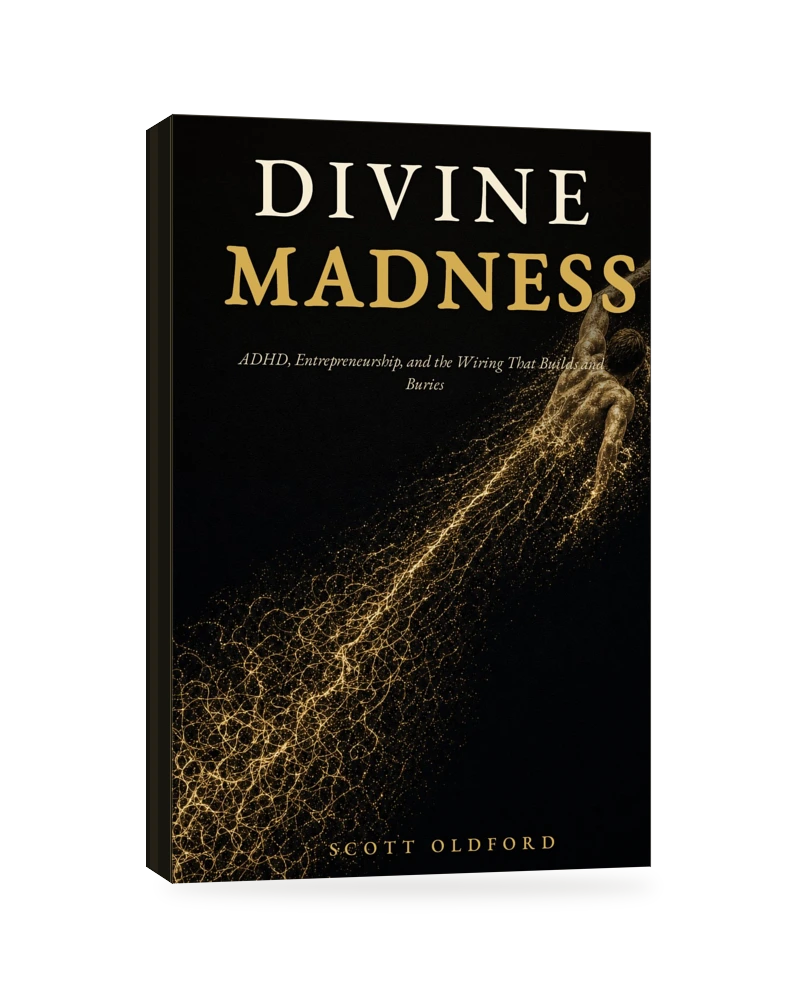
Divine Madness: ADHD, Entrepreneurship, and the Wiring That Builds and Buries is one of Scott Oldford's ten books, first published in 2026. It's part memoir and part operating manual for Entrepreneurs with ADHD wiring. Its argument is that the wiring doesn't need fixing. What's missing is a container: the regulation, systems and structure strong enough to hold it.
What the book argues
Most of what gets written for a brain like mine goes wrong in one of two directions.
The first is the superpower story. ADHD is your secret advantage, here are ten hacks and a morning routine. It feels good for about a week.
The second is the clinical story. The wiring is a disorder, so manage it down toward normal.
I spent years chasing normal. They were the most expensive years of my life.
The book takes a third position. The wiring is real, it costs real things, and normal was never on the table. So you stop trying to fix the brain and you build around it.
As I wrote in the preface: "You were never supposed to become normal. You were supposed to build something strong enough to let you be exactly what you are."
The five parts
The book runs 31 chapters in five parts. Every chapter ends with a short section called Your Turn.
The Wiring. What this brain is and how it runs, described as a machine with a design. Why it floods on interest and goes dark without it. Where the name came from, after thirty years without one.
The Cost. The bill. The money, the health, the businesses that worked and then didn't, and the crashes that kept arriving in the same shape. I put the cost before any of the fixes on purpose.
The Container. Where the book turns from diagnosis to building. Regulation first, then structure.
The Six Pillars. Marketing, Sales, Offers, Delivery, Operations and Finance. Each one rebuilt for a brain that goes prolific and then silent.
The Life. What the wiring costs the people who love you, where I am right now, and how to keep building.
Same wiring, two outputs
This is the idea the rest of the book stands on.
As I wrote in the book: "Same wiring. Two outputs. The dial between them is not effort or discipline or willpower. The dial is the state of the nervous system running the wiring."
Spiked, this brain gives me the launch high and the expensive mistake. Regulated, the same brain gives me focus that compounds.
Regulation doesn't cure anything. The trait is stable. What changes is which version of me shows up.
So the order in the book matters. State comes before structure, because a dysregulated operator breaks every system he builds.
The container
The container is my word for the structures that hold when I don't.
The book builds it as five walls. Near the end there's a one-page version called Start Here, and it scores each wall with one question, in these words:
Capacity. Does income keep arriving if you disappear for thirty days?
Memory. Does your best thinking live somewhere outside your head?
Executive function. Does your worst dropped task have a home in automate, delegate, or discipline?
Money. Can you say your floor number cold, right now, defended by something automatic?
People. Can the people around you run for weeks on a rough signal, without you being their weather?
A few of the tools inside those walls have names.
Capacity Before Calendar. I work in hot windows and go all the way in when one opens. The calendar gets built around capacity.
Frameworks as Prosthetics. This chapter explains where the ROI Method, the 3 Lane Method and the Levels came from. I built them first as a survival tool. As I wrote in the book: "The framework is the memory I don’t have, externalized into something that doesn’t forget."
The External Brain. The systems, tools and people that catch what my brain drops. The chapter also covers the cost of leaning on them.
The Thermostat. A money floor, set on purpose and defended by systems that don't need me paying attention.
The six pillars, and where agents come in
Part four runs shorter and more operational than the rest. Each pillar gets the same treatment: how the wiring wrecks it, then the build that fixes it.
One thread runs through all six. Every pillar used to need my attention, every day, and I couldn't supply it. What changed that was building AI agents to hold each pillar.
As I wrote in the book: "I give the signal. The system does the sustaining."
If that's the part you came for, Scaling Agents is where I teach it on this site.
Build for the crash
The last part carries the principle the whole book has been building to.
Build assuming the crash is coming. For a brain like this one, I think it always is. The only thing you control is whether there's shelter around you when it hits.
In the book I call the first crash tuition and the second one a choice.
The book ends on one page of method. Name the pattern, score the five walls, pick the worst one, regulate first, do one thing this week.
What the book doesn't do
It doesn't cure anything, and it says so.
What's in it is my own experience with ADHD, illness and recovery, offered for reflection. For care, see a professional.
On medication, it gives both halves of the research and my own choice as one data point. Then it gets out of your way.
And I didn't write it from the far side. I'm still in it, and the book says so in the preface and again in the afterword.
From the book: The Honest Map
From the book
This is the opening of the book, in full, as published.
Most of what gets written for a brain like ours lies to you in one of two directions. I’m not going to do either, so let me tell you what both lies are, and then tell you the truth I built the rest of these pages on.
The first lie is the superpower story. You’ve read it. ADHD is your secret advantage, your hyperfocus is a gift, you’re not broken you’re brilliant, here are ten hacks and a morning routine and you’ll be unstoppable.
I understand why that story sells. It feels good for about a week. And then you’re back in the same hole you were always in, now carrying the added shame of having failed at being a superpower. The story turns out to be a nicer-sounding way of avoiding the truth, which is that this wiring costs you real things, and no amount of reframing makes the cost go away.
The second lie is the clinical one. The wiring is a disorder, a deficit, a list of symptoms to manage down toward normal. Just medicate, organize, try hard enough, and you can become a slightly more functional version of a person you are fundamentally not.
That story is at least more honest about the cost than the superpower crowd. But it points you at the wrong destination. It aims you at normal. And normal was never on the table for people like us. The years I spent chasing it were the most expensive years of my life.
There’s a third thing, and it’s the honest one, and it starts by refusing to flatter you, so you know up front where I stand.
You are not most entrepreneurs. The stories you’ve heard, that most founders are secretly ADHD, that the whole game is built for brains like ours, that’s the superpower lie wearing a statistic. It isn’t true. The large majority of entrepreneurs do not have this wiring.
What is true, and what actually matters, is that we are real and we are over-represented. The research consistently finds this wiring showing up more often among entrepreneurs than in the general population, both as a formal diagnosis and, more commonly, as the traits themselves, whether or not anyone has ever put a name to them. We turn up at a higher rate than the base population, without being anywhere close to a majority of it.
So you’re not the main character of entrepreneurship. You’re also not alone, and you’re not rare. You’re a real and sizable minority running businesses on hardware the advice was never written for. That’s the frame everything here stands on.
Two quick things before we go further, so nobody has to wonder whether they’re in the right room. I wrote this to entrepreneurs, because building businesses is the life I’ve lived and the one I can speak to without faking it. But if you don’t run a business, don’t put it down. The same wiring that wrecks a launch wrecks a career, a budget, a household, a relationship, and nearly everything here translates straight across. Read offer as whatever you’re on the hook to deliver, and keep going. And I’m telling this as a man, because a man’s life is the only one I’ve got to tell it from. If you’re a woman, know that the wiring underneath is the same even where my version of the story looked different on the surface, and that this brain gets missed in women far more often, so a name that arrived late is not a name that arrived wrong.
One more door I want to hold open. I write ADHD throughout, because it is my diagnosis and the wiring I can speak to from the inside. But almost nothing here stays neatly inside that one label. If you are autistic, or AuDHD, or wired in some other way the world keeps calling a disorder, you will likely recognize most of this as your own, because the thing I am really writing about is a mind built on different hardware than the one all the advice assumes, and the container I am going to show you how to build works the same for a lot of us who never fit the standard machine. I will keep telling my specific story, because specificity is the only thing that ever tells the truth. Take what fits your wiring and leave what does not.
Because almost nobody says this part out loud. Nearly every piece of business advice you’ve ever been handed was written for a different brain. A brain that does boring on command. A brain that executes the same plan on Thursday that it made on Sunday. A brain that finds steady daily output not just possible but natural.
That advice works fine for the person it was written for. It’s just not written for you. Measured against a ruler built for that other brain, you will lose every single day and slowly conclude that the losing is a character flaw. It isn’t a flaw at all. You’ve been running the wrong operating manual on the right machine.
So here’s the different thing I’m offering. Not a way to fix your brain, because your brain is not broken and cannot be fixed and does not need to be. Not a promise that you’ll become normal, because you won’t, and you’d hate it if you did.
What I have instead is a map. An honest one, drawn by someone who has taken this wiring all the way up and all the way down. Someone who built things worth millions and lost more than ten million. Who has been on the bathroom floor at the peak and in a bathtub at the bottom. And who finally, after twenty years, worked out that the wiring was never the problem. The regulation was the missing piece, and the container was the thing I never built.
There’s an old phrase for the thing I’m describing, and it’s where this book got its name. The madman and the genius drink from the same well. The wiring that makes you brilliant and the wiring that makes you a wreck are not two different systems fighting for control of you. They are one system, the same voltage, running to both ends. The divine madness is no poetic flourish. It is the literal condition of a mind that runs hot enough to see what others miss and hot enough to burn down what others would have kept. Most people spend their lives trying to kill the madman to save themselves, and they murder the genius in the same stroke, because there was only ever one of them. This whole book is the argument for a third option. Not killing the madness. Containing it, so the genius it’s fused to finally gets to do its work without the wreckage. Hold that phrase as you read. Everything comes back to it.
You’ll get the whole thing. Where the wiring comes from, and why entrepreneurship felt like the first room that ever fit. What it actually costs, in the dark stretches most people too invested in the superpower story will never write down. The single realization that turned all of it around. And then the build itself, the container, the concrete, the systems that let a wild and unreliable brain produce work it could never produce by trying harder.
Stop performing normal. Build for the brain you actually have.
Everything after this page is how.
Who it's for
It's for the Entrepreneur who runs at a boil or runs cold, with no middle.
The one who can build at 2am in a fever and then lose a whole Tuesday to a ten-minute task. The one whose business is working while they aren't.
You don't need a diagnosis to read it. The book says the traits show up far more often than the label does.
And if you don't run a business, the opening above tells you how to read it anyway.
Who it isn't for
Skip it if you want ten hacks and a morning routine.
Skip it if you want to be told ADHD is a superpower. The book spends a whole part, five chapters, on what the wiring cost me.
Skip it if you want medical guidance. The book won't tell you what to do about medication.
If you want a business playbook with very little of my own story in it, read The Nuclear Effect or Read This If You're Scaling.
Where it sits in the ten
I think this is the most personal of the ten.
Million in the Red covers some of the same years from the money side. The Pattern names the patterns that run under pressure. The Levels of Consciousness is the book on state. Human First is the book on AI and what stays human.
You can read Divine Madness without any of them. If the container chapters land, The Levels of Consciousness is the one I'd read next.
The full map is on the reading order page.
FAQ
What is Divine Madness about?
Divine Madness is Scott Oldford's book for Entrepreneurs with ADHD wiring. It covers how the wiring works, what it cost him, and the container of regulation, systems and structure he built so the same wiring could build a business without burning it down.
Do I need an ADHD diagnosis to get value from Divine Madness?
No. The book is written for Entrepreneurs with the traits, whether or not anyone has put a name to them. It also says most of it applies to other kinds of minds the standard advice wasn't written for.
Is Divine Madness a medical book?
No. It describes the author's personal experience and cites the research it draws on, with a reference list at the back. It says in its opening pages that it is no substitute for care from a qualified professional.
Do I need to read another Scott Oldford book first?
No. Divine Madness stands on its own. For more on state after it, The Levels of Consciousness is the next read.
How long is Divine Madness?
Thirty-one chapters in five parts: The Wiring, The Cost, The Container, The Six Pillars and The Life. The hardcover is 378 pages.
Where can I get Divine Madness?
At getdivinemadness.com, in digital and hardcover. There is also a free eight-question quiz on that page.
Get the book
If the opening above sounded like your own head, the rest of the book is at getdivinemadness.com.
There's a free quiz on the same page. Eight questions, about two minutes, no email needed.