Book
Hold More
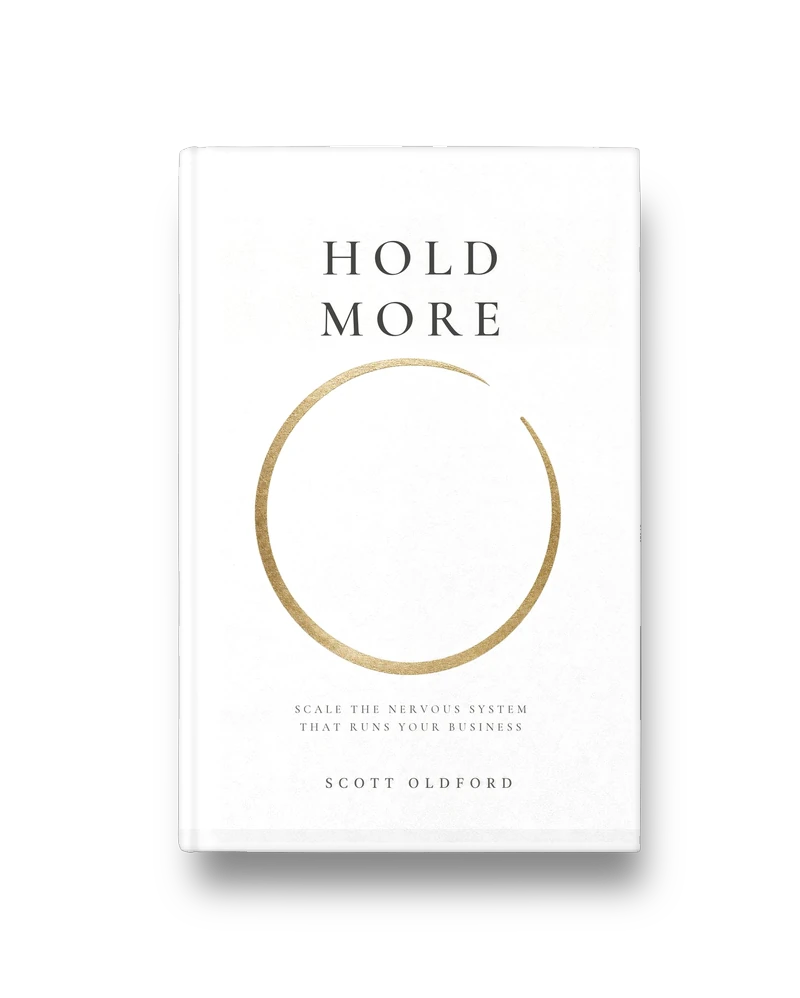
Hold More: Scale the Nervous System That Runs Your Business is one of Scott Oldford's eleven books, first published in 2026, and it's free. Its argument is that your business can only grow as far as your nervous system can hold, and that capacity can be trained. The book is the training manual: a four-phase cycle, a map of three states, five inputs you control and 31 practices.
What the book argues
On the last day of my first million-dollar launch, my girlfriend at the time found me in the elevator of our condo building in Toronto.
I was riding it up and down, standing in the corner, talking to myself.
That launch added 55,000 people to my email list in under a week. It was the biggest win of my life. My body couldn't hold it.
After the launch, I traveled and did nothing for months. I could not function.
Everyone prepares you for how hard it is to survive failure. Almost nobody prepares you for how much capacity it takes to survive success.
That's what this book is about. You can't scale a business, a relationship or your income past what your nervous system can hold.
If it can't handle more pressure, more responsibility and more visibility, your business will stop growing. You won't even see it happen.
You'll delay the launch. Avoid being seen. Collapse under the deadline.
Your system hit its capacity. That's all that happened.
The idea in one picture
- Your business grows.
- Your nervous system stays where it was.
- The gap gets too wide. So you pull back, or you crash.
- Capacity can be trained. Raise it, and the business has room to grow.
I did not learn any of this from a textbook.
I learnt it from 15 years of watching my own nervous system decide what I was capable of. It did that whether I gave it permission or not.
Then I watched thousands of Entrepreneurs go through the same collapses in their own way, on their own timeline.
A pattern in your body
I get asked all the time how this is different from mindset work.
Here's the simplest way I can put it.
Mindset is a pattern in your head. Nervous system is a pattern in your body. And you can't think your way out of a body pattern.
Mindset work is real. Your body needs a different set of tools.
For years, a FedEx truck pulling up to my door set off my whole body. Legal documents, tax notices, money I owed. Long after the debt was gone, the spike still fired.
Then one day the truck showed up and my first thought was: my juices are here. Same truck. Retrained system.
Capacity can be trained. That's what this book is for.
The four-phase cycle
This is the pattern you'll come back to again and again.
Part 1
Four phases, run in order. The practices under each phase are the ones the book uses to train it.
Awareness
You can't shift what you can't see.
Trained byThe State Awareness Snapshot. The Light Check.
Regulation
Finding center, no matter the storm.
Trained byThe 90-Second Reset. Breathe Into The Spot. The Stress Step-Down.
Capacity Building
A controlled dose of stress. Then recovery. Then a slightly bigger dose.
Trained byDeliberate Exposure.
Integration
Closing the loops and resting enough that your system can repair.
Trained byThe Loop Close.
Each time you run it, your recovery gets faster and your baseline goes up.
Get to baseline. Go a tiny bit beyond it. Give it time to integrate. Then repeat the pattern all day long.
Over time this becomes natural. You stop forcing it. It's just your life.
One test before you add any stress
Before you add any stress on purpose, answer one question. Are you stressed, or are you burnt out?
Those are two different conditions. They need two different protocols. Running the wrong one is how people spend six months getting worse while doing everything right.
One test before you start
Rest is the test. What happens after you rest decides which protocol you run.
You're stressed
You build capacity the way the book describes. Small, controlled doses of stress you choose.
What that looks likeCold. Hard training. The conversation you've been avoiding.
You're burnt out
The protocol flips. No stress on purpose at all until your baseline comes back.
What that looks likeWarmth instead of cold. Sleep instead of training. Subtraction instead of addition.
Let me be blunt about one of these. A cold plunge on a burnt-out system makes it worse.
Cold is a stressor. That's the reason it works when your system has room. When your system has no room, you're adding load to something already past capacity and calling it discipline.
Same with the 5am workout. Same with the fasting.
One more thing, and I mean this. If the exhaustion has gone on for months, go see an actual doctor. Get the bloodwork. Rule it out first.
Three states
Your nervous system works like a traffic light.
At any moment, you're in one of three main states: Reactive, Shut-Down or Resonant.
Part 2
Name the state in one word. Then match the tool to the state.
Reactive
Urgency, agitation, racing thoughts, clenched muscles.
Feels like"If I don't act right now, something bad will happen."
Reach forA calming tool. Slow breathing with a long exhale.
Shut-Down
Numbness, heaviness, mental fog.
Feels like"It's too much. I can't."
Reach forAn activating tool. Gentle movement. A short walk.
Resonant
Calm alertness, open perception, creative flow.
Feels like"I can hold this and move forward."
Reach forAn extending tool, to stay there longer.
There's also a pattern that rides along with them, Fawn. The book shows you that one too.
Once you can identify each state, you can read your own operating system in real time. Then you know which tool to use.
The wrong tool can make it worse. A hard workout when you're already Reactive and wired can spike you further into agitation.
Five inputs you control
A lot of things affect your nervous system. Only some of them are directly under your control.
Think of these five inputs as levers. You can pull them every day to shift how you feel, how you perform and how quickly you recover.
Part 3
Five levers you can pull every day. Every one is free.
Breath
The fastest, most direct way to signal safety to your nervous system, or to wake it up.
Environment
Your surroundings feed sensory information to your brain all day.
Movement
Movement burns off stress chemistry and tells your body it's alive.
Focus
What you pay attention to changes your physiology.
Connection
Safe human connection is one of the strongest regulators your nervous system has.
It's so simple and so cheap that nobody can bottle it and sell it to you. That's exactly why it works.
It's just you and you. There's no device on your head and no subscription to pay.
Four stages of capacity
The first time I ever had to let someone go, I was 19. One employee in her late twenties, crying in my office. My nervous system was wrecked for days.
In 2019, I fired 44 people on a single Zoom call. The capacity had grown, but my system took it about the same way.
Today I could make the hardest personnel decision my business required and stay completely regulated inside of it. Still sad. Still human. Still not wanting to do it. But held.
Same person. Same kind of event. A nervous system that finally grew into it. That's what these stages map.
Part 4
Where your system is now, and what the next step up looks like.
Baseline Regulation
You can return to center when everyday stress hits.
Expanded Window
You can stay regulated even under higher pressure.
Peak Frequency
You can move between intensity and stillness without leaving residue in your system.
Transmission State
Your regulated state co-regulates others.
You don't live in Stage 4 permanently. Nobody does.
The 31 practices
Pick one practice. One. Run it every day for a week before you add a second.
Most people ignore that instruction. That's why most people get nothing out of books like this.
Doing 31 practices once each will do nothing for you. One practice done 21 days in a row will change your baseline.
Parts 1 to 6
Every one is written the same way, in five parts.
- What it is.
- Why it works.
- How to do it right now.
- What it feels like when it lands.
- How people get it wrong.
- The State Awareness Snapshot
- The Light Check
- The 90-Second Reset
- Breathe Into The Spot
- The Stress Step-Down
- Deliberate Exposure
- The Loop Close
- The Three-State Read
- The State-Matched Tool Pick
- The Yawn Reset
- The Extended Exhale and the Physiological Sigh
- The One-Room Audit
- Structural Boundaries
- The Two-Minute Discharge
- Single-Thread Blocks
- The Co-Regulation Call
- Everything And Nothing
- Two Levels Up
- Money Coming In
- The Anchoring Practice
- The Morning Set
- The Evening Close
- The Weekly Leader Reset
- The Six-Hour Replay
- The Body Vote
- The Baseline Check
- The Objection And Intention Drill
- The Sabotage Check
- Your Mirrors
- The Six-Question Decision Filter
- Engineer The Level
And keep it small. If you literally just spend three minutes, six times a day, on this, that's less than 20 minutes.
I'll also tell you it's the hardest three minutes you'll spend. Your little mind will tell you that you need to write an email or do a social post first.
Part 5 turns the practices into a daily operating rhythm. Part 6 lays the Levels of Consciousness over it. The book closes with a seven-day plan and a 30-day plan.
What the book doesn't do
Nothing in here is medical advice, and I'm not a practitioner. If you're dealing with trauma, a clinical condition, or anything that needs real care, get that care. This book won't replace it, and I wouldn't want it to.
You'll also find boxes through the book marked "What the research says." Where the evidence is strong, I say so. Where it's thin or contested, I say that too. There's a full source list at the back if you want to check any of it yourself.
And I'm not promising you a different life in 30 days.
From the book: Start Here If You Are Breaking
From the book
This is the first page of the book, in full, as published.
Maybe you opened this book in the middle of a panic attack. Maybe it's the worst week of your year. Maybe today is the day the whole thing came apart.
If so, this page is the only page you need right now.
Skip the rest.
Don't read my story. Don't read the research. Don't read the frameworks. None of it will help you in the next 10 minutes, and trying to take it in will make you feel worse.
Do this instead.
Breathe in through your nose. Then breathe out through your mouth, slowly. Make the exhale longer than the inhale. Longer out than in. That's the whole instruction.
Keep going for two minutes. Ordinary breathing, with the out longer than the in.
Your body reads a long exhale as a signal that the threat has passed. It's the fastest lever you have. It works whether you believe in it or not. It comes from the extended exhale and the 90-Second Reset later in this book, stripped down to the pieces that move your system quickest.
While you're doing it, drop your shoulders. Unclench your jaw. Look around and name three objects in the room.
When the two minutes are done, do it again if you need to. Most people need to.
Now the second instruction. It matters as much as the first.
Don't make a decision today. No quitting. No firing. No sending. No ending anything.
Your system is in alarm. A body in alarm makes decisions it has to live inside for years. The decision will still be there tomorrow. And tomorrow you'll be able to think.
The book will still be here too.
One more thing, and I mean it. If you're in real danger, if you're thinking about hurting yourself, or if what's happening to you needs clinical care, put this book down. Call someone. A doctor, a crisis line, a person who can get to you. Get real help and come back to this later.
When you can breathe again, take the burnout test in Part 1 (Stressed or Burnt Out?). Then go to the seven-day plan in the Closing. Everything else can wait.
Who it's for
- You run an online business and you've hit a ceiling more strategy hasn't moved.
- You pull back right when things start working.
- You're a numbers person and this sounds like woo. I thought exactly that, for years.
- You want one practice you can start today.
Who it isn't for
- You want funnels, ads or tactics. There are none in here.
- You need clinical care right now. Get that first. This book won't replace it, and I wouldn't want it to.
- You're looking for a promise of a different life in 30 days. I won't make one.
Where it sits in the eleven
Hold More is the training manual for one law. I named it in The 33 Energetic Laws: Law 3, the Law of Energetic Capacity. The Levels of Consciousness is the book on state, and Part 6 of Hold More uses that model. Divine Madness covers the same ground for ADHD wiring. You can read Hold More without any of them. The full map is on the reading order page.
FAQ
What is Hold More about?
Hold More is Scott Oldford's free book on the nervous system behind a business. It argues that a business can only grow as far as its owner's nervous system can hold, and it gives a four-phase cycle and 31 practices to train that capacity.
Is Hold More free?
Yes. The digital edition is free at readholdmore.com. You enter your email address and the book is sent to you.
Is Hold More a medical book?
No. It's education and general information. The author is not a licensed practitioner, and the book says so on its copyright page and again in its opening pages. It tells readers who need clinical care to get that care first.
Is the research in Hold More cited?
Yes. The research is cited in a Notes and Sources section at the back. Boxes marked "What the research says" state where the evidence is strong and where it is thin or contested.
How long is Hold More?
138 pages. Six parts, 31 practices, a seven-day plan and a 30-day plan. Five of the practices sit in a section at the back called Go Deeper.
Do I need to read another Scott Oldford book first?
No. Hold More stands on its own. It builds on Law 3 of The 33 Energetic Laws, the Law of Energetic Capacity, and can be read before or after that book.
Where do I start if I'm overwhelmed right now?
On the first page of the book. It's called Start Here If You Are Breaking, and it's printed in full on this page.
Get the book
If the ceiling feels familiar, the book is free at readholdmore.com. Pick one practice. Run it every day for a week before you add a second. The book shows you which one to start with.
Get the free book